



We’re at the home stretch of 2020, and as much as we’d like to live these last few weeks in comfort, Google had other plans for SEOs. Say happy holidays to the December 2020 Core Update.
It seems like awkward timing. However it’s better than it happening one week earlier, possibly disrupting Black Friday and Cyber Monday online sales. So I suppose there was some level of kindness baked into this release.
The update appears to have begun rolling out on 1pm ET December 3rd (about two and a half hours after Google’s announcement), but it’s likely we’ll see the rollout affecting SERPs for the next week or two, as is typical with these core algorithm updates from Google. However many online, and within 97th Floor's clients have seen fluctuations happening earlier this week, possibly indicating a soft rollout earlier than the official announcement.
Granted it’s been only 24 hours since the results started rolling in, but even still, there are some trends to make note of.
First and foremost, E-A-T (expertise, authority, and trust) has come out as a prevailing set of metrics that determine a positive outcome for sites during this unforeseen update. It’s worth taking a second to remember the May 2020 Core Update, which was a larger than average update, negatively affecting many sites that were not prioritizing E-A-T. It seems that authoritative backlink profiles are a major factor, as they were in the May update.
When reading between the lines on all the forms online concerning the update, it’s possible to infer that many old-school (AKA blatant black-hat) SEOs are feeling the burn of decreased rankings and traffic right now. Much of the May 2020 Core Update also systematically penalized these kinds of sites as well, and it seems that sites that continued to avoid holistic SEO fixes are feeling the heat today.
Ever since the infamous Medic Update of August 2018, many are looking for specific industries hit by these updates, which hasn’t been the case in the same severe way the Medic update was. However, the auto industry seems to be taking more than its share of shake ups today. I would also note that legal sites (and heavily regulated industries in general) are seeing fluctuations.
As helpful as it is to hear Google say, “Our guidance about such updates remains as we’ve covered before,” I want to provide more specifics.
First and foremost, make E-A-T a priority for your site in every aspect, especially link acquisition. A number of big brands are gaining valuable ground on their SERPs, which in itself is very insightful. However, when looking at these brand’s backlink profiles, we’re seeing big link wins in the past 6 months. Double down on real link-building, the kind that passes authority, is indexed, and respected by Google. This can be done by leaning on things like guest post link building and branded link mention reclamation campaigns
Make sure you are accurately documenting your site's success or failure during this update. This update is terribly hard to diagnose with recent traffic, given that last week was a major holiday in the US. So when looking at your position, trust keyword positions over traffic for the time being.
As always, be sure to report this information to your team members and managers with a link and some screenshots from your own ranking and traffic numbers. Explain what E-A-T is and then devise an action plan of what E-A-T means for your site and brand, it will likely involve better content and links.
Reach out to me on Twitter @Joe_Robledo_ with any questions or updates.
2020 is an unusual year. Nothing can be assumed, and shopping trends are no exception. We at 97th Floor commissioned a study that dove into all of the newest trends in Black Friday and holiday shopping. Our objective: to help marketers prepare for this unusual season. In this post we’ll look more closely at some of the most interesting data points specifically around email, and how they might affect your marketing strategy.
This year, shoppers are getting a head start on their holiday lists. 54% of shoppers say they want to do their holiday shopping by early November to avoid crowds, and 68% of shoppers say they’ll be moving online. As marketers, we need to meet our customers where they are. This year, that means online and early.
Because shoppers want to get their shopping done earlier, you should consider emailing them earlier too. Don’t be afraid to email more consistently during the holiday season; shoppers expect to see more emails this time of year, so it’s a great time to take advantage of that as an opportunity to push your brand’s value and story.

Ultimately, the end goal of any email track is to lead your contacts on a journey. You can use email to tell your story, and to explain your value. Use your email marketing this holiday season to build a story for your products. Like J. Peterman’s famous catalog illustrates (pun intended), the way that you present your products must be more than an explanation: it needs to be a story. Best case scenario, even your presentation will be a kind of art. Don’t underestimate the importance of this. Email is a great way to control the way your product is positioned and presented.

Email marketing is the way you’ll be able to take people with casual interest in your products and turn them into true fans. This holiday season, treat all your email contacts like they are at least mild fans of the product (a safe assumption as they did give you their email) and turn them into mega-fans of your brand.
Our stats say that 81% of shoppers aren’t sure they’d head to brick and mortar locations even if the retailers offered great in-store experiences for the holidays. In fact, 88% of parents even say they won’t let their kids sit on Santa’s lap this year. Yet we know that experience is everything. So this holiday season marketers need to turn their attention to the digital sphere.

Be sure that all of the content you put out this season, including your email, provides an enjoyable experience for the user. This includes your website and landing pages. Take a look at the ease of use on your site — can users easily navigate your site to find what they need?
Get inventive with the way you use email as a part of an experience. Create amazing digital experiences and use email to share the opportunities with your audiences. For example, share social media campaigns your audiences can interact with, like zoom calls with Santa, an interactive about how your business works, or whatever the digital experience is that fits best with your business goals. Consider building out a multi-part, text-based experience for your email marketing, something that your audience will look forward to engaging with on day 1, but also day 3, 5, and 9. A story (see below) is one option, but any content that can be broken up in a linear fashion can be turned into an email experience.
Email is an effective way to spread the word about--and create--the experiences you have going on this holiday season; be sure you make the most of it.
Consider which metrics are most important for you, and then track them diligently. For brands just starting on their email marketing, your open rate might be your top priority. More mature email marketers will probably want to make their top priority either CTR (click through rate) or CToR (click to open rate).
The important thing is that you don’t just launch your emails out into the world like fledgling birds where they will either fly or die. Pay attention to performance, experiment, and continually tweak things to see how it affects outcomes. As an agency, we spend a lot of time measuring performance -- it’s our lifeblood. If we aren’t producing results, we lose your trust and your business. For you, in your business, you can afford nothing less.
The age of impersonal email is long behind us. There are many simple, easy ways to make your email copy individualized for your audiences, and they are common enough that they have become expected best practices, not only from savvy marketers, but the everyday consumer. When getting ready for a large-volume push with many different email tracks, it can be easy to want to cut corners, talk generally, and forget what your audiences really want to see.
Use your list’s first names in the email greetings, and choose the email track you put your contacts in based on their specific interests and issues. This will be a busy season, so everyone is about to get busy inboxes. If you want your emails to stand out, get personal. Put in the extra effort, use the research and data you have on your contacts and put it to good use.
It’s easy to fall into the trap of personalization-for-personalization’s-sake. We don’t personalize just because we can, but because it works. However this comes with a risk, too. If you’re not careful, personalization can come across as smarmy, too familiar without cause. This can turn off customers and lose business. The solution is simple: use personalization as a way to show respect for your customers, to demonstrate that you are thinking of them not as a patsy or a mark, but as a valued individual. Use personalization not to manipulate your audience, but to humanize them. Do it because you truly do value and respect them. It’ll show -- and it will help your bottom line.
If you’re not doing email marketing today, now is a great time to get started. Don’t wait until you have every single piece nailed down, even a moderate effort can be valuable. If you are doing email marketing already, now’s the time to ramp up your efforts and improve your process. Get personal, pay attention to your metrics, make it an experience, and build a story. Yes, it’s hard work, but it’s worth it (and we can help!).
May your holidays be bright with email marketing success.
Many retailers use the holidays to end their fiscal year with a bang. This year, many marketers, especially retailers, are putting their hopes in the 2020 holiday season to capture revenue at the tail-end of what has been a hard year. 97th Floor’s latest study dove into all of the newest trends in Black Friday and holiday shopping to help marketers prepare, and in this post we’ll dive deeper into how these insights might affect your ad strategy this season.
COVID-19 has shifted every business’s strategy and planning in 2020. As cases continue to rise, holiday shopping trends are no exception. This season, 68% of shoppers say they plan to do most of their shopping online due to COVID, and 52% of shoppers say they expect they’ll never shop in person for the holidays ever again.

Things are changing, and marketers need to keep up. Especially this holiday season, it will be imperative that marketers make the most of the newest consumer trends. The changing market will likely mean many advertisers will be prioritizing ads for their holiday campaigns, so marketers need to look at what that will mean as far as higher costs in the ad platforms, etc. and need to be ready to traverse the new waters with skill.
Here are a few tips to make the most of your ads this 2020 season based on our recent data.
For two months in a row, Facebook’s CPMs have risen by 10% — reaching a record high for 2020. Higher costs might mean that your strategy needs to pivot. Be sure to place pixels from other platforms on your site so that you can hold onto your followers in case you decide to pivot to other ad platforms that may be less expensive.
With virtually every retailer trying to make up for lost ground earlier in the year, you can bet you’ll see more competitive bids, decreasing your ROAS. Facebook will likely become an incredibly competitive market, with costs continuing to rise. This season, be prepared to switch platforms and pivot to make the most of your budget.
This holiday season, your ad copy and creative needs to stand out, but you already knew that. What you might not know is that only 20% of shoppers say they're definitely in “a shopping mood” this holiday season. Advertisers need exceptional copy and creative to earn clicks and conversions from their audience this year.
Even stores that are used to pushing in-person sales will be moving online, and users will be inundated with ads. Advertisers need to be leaning into their established personas to create copy and creative that speaks to your audience. Even if you have high performing ads, they will likely need a refresh with a holiday angle to ensure they are speaking to your persona during the holiday season.

Savvy advertisers will have already built a deep retargeting pool months ago that they can lean into heavily during the holiday season. So while it might be too late to build a retargeting pool for this season’s retargeting efforts, the holidays could be a perfect time to build that pool for future efforts.
If you can gain a solid retargeting pool, it will give you the leg up in your future endeavors (like starting 2021 off with lower CPCs). Retargeted audiences are some of the most likely to convert, and that’s what ultimately matters over any kind of wide reach or visibility. Figure out ways to get qualified traffic to your site en mass, even if it’s not on a product page, and then use pixels to add them to your remarketing pool. And who knows, focusing on building that pool might just bring you conversions this season too.

This holiday season will be different than anything we’ve experienced before. Advertisers should prep their leadership with accurate numbers, as 73% of shoppers plan to spend either as much or less than they did last season.
Monitor your channels closely and be ready to pivot as needed. Don’t lose track of your CPM or CPC prices, and be strategic with your budget as costs rise. Stay hyper aware, or you’ll find yourself paying a lot more per ad. And look to the future (yes, there’s hope beyond the holiday season)! Build your remarketing pool, and prepare for an audience base that has the potential to stay largely online, even once the COVID crisis ends.
COVID-19 cancelled a lot of plans in 2020. Teachers. Doctors. CEOs. Politicians. Parents. Children. Travelers. They’ve all had to adapt to The New Normal. With Black Friday approaching, we’ll add retailers to that list.
Most retailers rely on Black Friday doorbusters to make their year profitable, and this year Black Friday is even more important to many retailers as they’ve suffered with shutdowns, lockdowns, and letdowns.
97th Floor has helped hundreds of brands find success during their holiday marketing push, but we’ve never done it in a year as unique as 2020. We wanted to know how shoppers would react to these changing times, so we commissioned an independent research study of 1,000 US shoppers to understand their hopes, fears, and behaviors when it comes to crowded malls, bustling stores, and online shopping this holiday season.
We’ve put together some of the most interesting insights in this article, but all the data can be seen in the PDF download attached to this article.


It’s true that this has been a difficult year for business. However, there are steps that you can take to safeguard your own sales as the holiday season approaches. Our advice? Focus your efforts online. 97th Floor will be releasing a small series of in-depth articles covering these topics deeper.
Sign up for our monthly newsletter to make sure you don’t miss one.
Some SEO tactics take months to see results, but the holiday shopping season is already upon us. So, this year we’d recommend finding that sweet spot between SEO that works for ecommerce sites and the SEO practices that yield results quickly. A few “quick wins” you should look at to increase the readability and user-friendliness of your site are product schema markup, proper rel=canonical for duplicate product pages (for holiday special prices for example), appropriate redirects, claim unlinked brand mentions, strategic internal links, and title tag adjustments.
Many brands can expect an influx of traffic during the next two months, so this could be a good time to roll out some testing in order to capture revenue from as much of that traffic as possible. Small changes can make a big difference on your site — one of our clients saw a 29% increase in revenue in just 18 days, without any increase in traffic at all. Imagine the possibilities as traffic does increase this holiday season. Our advice? Get started testing as quickly as you can. That way, when traffic really starts to peak, you know you’re getting that traffic to the most optimized versions of your pages.
It’s difficult to predict what will happen with ad auctions and CPCs during the holidays, but it’s certain prices will go up. Perhaps more this year than any other year since so many brands are hoping to make up for poor performance in previous quarters. Work to get more traffic right now, so that you can form remarketing campaigns later, which will be cheaper and more effective than cold ads. This might mean getting ads out the door earlier than you may have planned. Additionally, get all of the pixels you can active on your site. Even if you are only running Facebook Ads right now, still include pixels for Pinterest, LinkedIn, and Google if appropriate. Doing this will allow you to quickly pilot to new platforms if rising prices caused by holiday influxes on your platform of choice push you out. This will help you keep a steady ROAS.
Keep in mind that people are more likely to try a new product or business during the holidays, so if gaining new customers is a focus for your business, this is your time to shine. Monitor all of your channels closely, as well as CPM and CPC. Become hyper-aware so that you don’t end up paying more than you’d like per ad. Also, build your remarketing pool earlier and be ready to pivot.
Email is a channel that deserves more attention this holiday season. Work on more specific segmentation, increase your email frequency. A greater volume of emails is much more acceptable by most users this time of year, so it’s a great time to show them all the value you can), and be sure to keep it personal. There are little things you can do to add personalization to your emails, such as personalization in both copy and context, that make a big difference to those on the receiving end. Email your contacts based on their interactions with you, as well as the information you already know about them. When the situation is more specific, your emails are more likely to be effective.
There is no doubt that this holiday season will look different than any that has preceded it. Yet, even in 2020, there is still room for success when you plan strategically. Strive to work with the times rather than against them. The data collected in this study can be used to help tell a more accurate story this holiday season. And, taking to heart these suggestions, you can be armed to take this challenge head on — and hopefully see incredible results in the process. We’re going to be dropping more specific articles on our blog throughout this season, so be sure to follow us on social media and subscribe to our newsletter so you don’t miss a thing!
Many ecommerce businesses begin with a D2C model, selling quality products on their own site while dreaming of the days they’ll hit it big by getting serious traction in a major brick and mortar.
It’s a big step and an exciting achievement, but it also carries risk. As you push your product through bigger stores, you give up control over your brand and your ability to connect directly with your customers. It’s often a matter of trading control for (hopefully) greater volume.
This was Zhou — a nutrition brand thrilled to fulfill their longtime goal of seeing their product in 433 Target stores across the US, but worried about the new lack of control. They wanted to retain a hand in their own success, and see that their entrance to Target was a success in terms of actual foot traffic and revenue.

Zhou presented 97th Floor with a fixed budget for advertising in 433 specific locales. The task was one Zhou had never attempted before — drive foot traffic and sales with Facebook Ads to physical Target locations through geo-targeting, in addition to Target’s online landing page. Driving and tracking success via Facebook Ads to your own landing page is easy to track and control, but driving foot traffic to a secondary store is another story.
Ultimately, the strategy and results were so positive that after two weeks, Zhou found extra budget to push towards these ads.
It’s quite a triumph when longtime D2Cs enter big-time stores like Target. But success isn’t guaranteed. The D2C still has to do the work of getting their brand recognized in stores, and pushing foot traffic into those stores to actually buy the product.
In order to start off with a bang and keep the momentum going long term, Zhou allocated some budget to getting products moving in the locales they were entering. Pushing that traffic, especially in those first few weeks, would prove critical in making their transition into Target stores a success.

Zhou came to us with a moderate budget, but when split over 433 different markets even a sizable budget goes pretty fast. We began with a total budget of $30,000, which meant each store got only $4.62 in daily ad spend. This meant we had to be pretty picky and intentional about where we put our money. The tactics we used had to be effective and incredibly targeted. We also ran this project for just two weeks, so time was of the essence. After those first two weeks and initial $30,000, Zhou was so impressed with the results that they decided to push an extra $10,000 toward another five days of campaigning.
We decided that higher click through rates and lower cost per clicks would be the best markers for our success in this particular campaign. In addition to revenue information gathered from Target. This was because we weren’t trying to drive sales directly, but rather foot traffic to brick and mortar Target locations as well as their online landing pages.
The two products that Zhou placed in Targets were Collagen Peptides and Hairfluence supplements. The primary target for these products were women, so we catered our copy and ad images towards that demographic.

We built out a strategy with ads for 160 different geo-targeted markets, including up to 27 stores within each market. The Target logo was prominent in the ad visuals, highlighting that the product was now available at Target. That math adds up to thousands of different geo-targeted ads, each directed at their specific markets. And, to complicate things even further, we wanted all of them to go up within Zhou’s first few weeks inside Target.
With that great volume of ads to set up in such a short period of time, we knew we had to be careful how we approached their launch. If we put them all up at once there was a high likelihood that the Zhou account would be disabled. Which would throw a real wrench into the already time-sensitive campaign. So, we played it safe and uploaded them in batches, day by day.

This turned out to be a strategic advantage, because after the first week, we located the underperformers and pulled them, reallocating their budget to the highest performing ads and locales. This helped us make the very most of the budget, and see quicker and more substantial results from our efforts. It’s always a good feeling to put your money where the data is.
We also created a live dashboard with Google Data Studio so we could see the performance of our ad variants across all locations in real-time. We shared this with the executives at Zhou and their parent company (Nutraceutical) who then shared it with Target. Target was able to provide us with in-store conversion data, allowing us to truly see the impact of our efforts on the bottom line. At this point, Zhou, thrilled about the increasing conversion rates, sent that extra $10,0000 to continue the campaign.

Together, Zhou and 97th Floor truly revolutionized the process of entering brick and mortar stores as a D2C. Zhou kept control of their brand, and pushed customers toward their new Target locations. No longer do D2Cs just have to sit back and hope that greater volume will mean greater results. Instead, they can still have a hand in their own success.
And, it wasn’t just Zhou that profited. This strategy was a win-win for both Zhou and Target — Target gets customers in their doors, and Zhou gets revenue and product recognition. This ad strategy and real-time dashboard were so successful together that Zhou now uses this framework as a playbook when guiding new product lines to enter big retailers like Walmart, Sam’s Club, Costco, and more.
Ultimately, Zhou saw a 27.46% increase in in-store purchases in just one week of this campaign. Proving to themselves, and other curious D2Cs, that profitable partnerships with big-names like Target are not only possible, but probable, with the right ad strategies.

Often digital and brick and mortar marketing are seen as opposites rather than partners, but Zhou proved that it doesn’t have to be that way. Online shopping might be the new frontier, but there will always be a place for the convenience and experience of local brick and mortars. Zhou and 97th Floor’s partnership led to great results, revolutionary processes, and a successful start to Zhou’s product pushing in Target.
Zhou kept control, but was able to take advantage of Target’s wide reach. Now, Zhou is looking for even more products that they can push through this process and get inside of brick and mortar stores.
Political campaigns are some of the most visible, wide-reaching, and polarizing marketing campaigns. They operate off of enormous budgets with highly condensed timelines, and digital strategy has become an increasing priority as audiences shift online. But even Presidential marketing has its oversights and faux pas.
At 97th Floor, we were curious about how these two campaigns were tackling digital, so we decided to utilize our expertise in performing large-scale audits for both the Biden and Trump 2020 campaigns. We have the best specialists in all of these fields, and we asked our teams to treat these campaigns just as they would a client, auditing every inch that they could.
After pulling thousands of digital ads, reviewing millions of dollars in ad spend, pouring over scores of website pages, reading hundreds of emails, and scouring mobile apps and social media accounts, we found hoards of fascinating insights. It’s a drama-- massive oversights, well-timed reactions, wasted dollars-- but I’ll step aside and let the data tell the story.
After combing through both audits we cherry-picked and pulled the most engrossing snippets into the final version on GetThatVote.com. Read ahead here to see just a few of those highlights.

On a grand scale, the Trump campaign acts as one might expect: big budgets, pushy messaging, and dated tactics. But, while wasted budget is never a pro, the Trump campaign seems to understand its core audience. The campaign’s focus and budget, as well as messaging, are highly targeted to dyed in the wool, red “Patriots.” Team Trump’s digital tactics mirror that of the entire campaign — braggadocious — largely catering to those who are already his fans. Additionally, the Trump campaign presses much harder for donations, which could be one explanation for its ability to outspend the Biden campaign at every turn.
In contrast, Biden’s team hones in on the fringes and the undecided — those who have been historically election-determining, an obvious audience for this (and every) election. This showcases itself in a strong focus on swing states with budget, and a somewhat-humble focus on “togetherness” and “unity” in messaging. The Biden campaign also pushes for a professionalism and issue-based copy that Trump has largely overlooked. A little surprising is the consistently smaller budget from the Biden side, however it’s possible that Team Biden is holding back to increase spending when it matters most, that last month.
Overall, each site caters to the strengths of its candidate. The Biden site emphasizes unity in diversity, with photos of Biden with others rather than alone, and copy that includes words like “together.” Trump’s site leans into the fame of Trump himself. Mentions of specific goals or stances are overtaken by Trump-focused photos and messaging.

As far as general user experience and intuitive flow, Trump’s site takes the cake. Biden’s site overlooks clear messaging in conveying how to volunteer or get involved, and funneling every user into a narrow set of options. The Trump site uses very clear “get involved” messaging in their header, and gives various actions a user could take in order to show support for the campaign. Additionally, Biden’s website feels busy, and lacks an easily navigable hierarchical structure. Trump’s site is well structured, pushing users to either shop or donate.

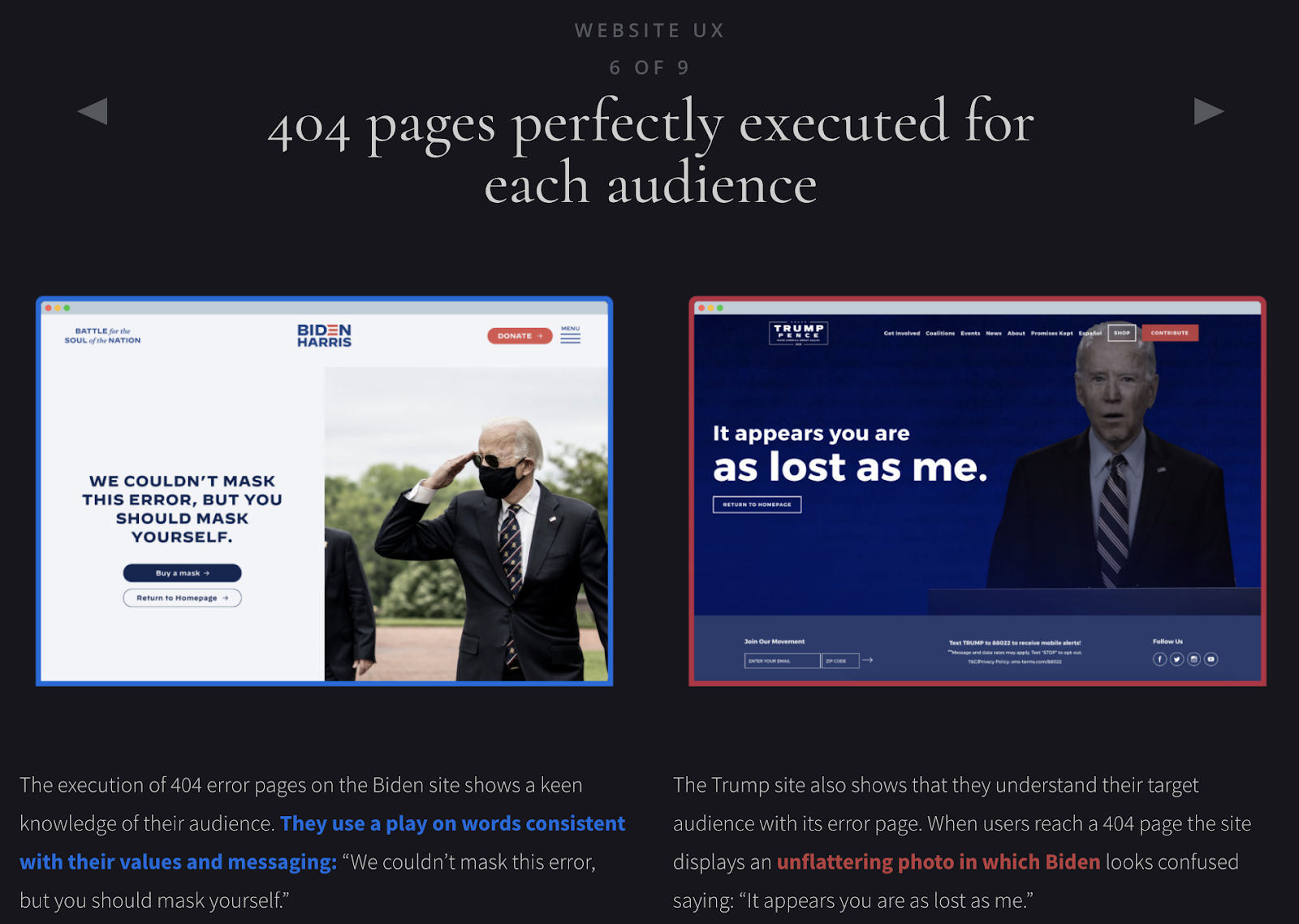
We also couldn’t help ourselves in looking at the 404 pages. Both perfectly represent their target audience: Biden’s responsible mask-wearers, and Trump’s anti-Bidens.
Neither campaign is leaning into search advertising heavily, with text-based search ads accounting for 11.48% and 10.09% of the Biden and Trump campaign’s Google Ad’s budgets respectively. They both make good use of the video elements of Google’s platforms, which may be based on the fact that video is a more immersive experience for the viewer, however it is unusual to see so little budget devoted to image ads given their ability for cheap, but effective remarketing.

The biggest misstep? The Trump campaign paid for the keyword “how to impeach trump.” One might think that this strategy is fascinating, and indeed it could have been, if paired with the right landing page. But when you look at other terms that received significant clicks, you’ll also find terms like, “speedo swim trunks,” “men’s xxl swim trunks,” “trump is a disaster,” and “trump fraud.” The Trump team was apparently not looking at their own search terms report. This oversight is easily fixable by adding negative search terms to their strategy.

Another key difference in strategy is that Biden’s team is using search to prioritize issues, while Trump’s team is here to sell hats (and other merch). Overall, team Biden is performing better in the Google Ads game. However, this is largely due to the fact that they’ve made fewer obvious blunders rather than their own strength on the platform.

I wasn’t impressed by the Trump campaign’s email strategy. The subject lines are flashy, even misleading, resorting to bait and switch tactics. Trump’s email team is pushing hard for donations. Ironically, however, the Trump campaign falters big time when it neglects to add emails entered into the footer of the website into any sort of followup email funnel.

With an average of 2.7 emails sent per day, one has to wonder about unsubscribe rates on the Trump campaign’s emails. The intended strategy may be to hit the audience hard to get recurring donations before they unsubscribe due to email fatigue.

The Biden campaign, on the other hand, seems to want to turn subscribers into advocates, only occasionally asking for donations. His campaign sends significantly fewer emails than Trump’s, with an average of one email every other day. The Biden campaign keeps the issues of their campaign central, and their subject lines helpful and professional. Overall, Biden’s email strategy has a clear advantage over Trump’s in its use of best practices.

Both candidates are running predictable and moderate social media campaigns. Biden is more active on Instagram than Trump, but it’s still surprising that neither candidate makes greater use of Instagram, considering the app’s large demographic of young, often swing voters.

The campaigns’ followers describe themselves in predictable ways: “she/her,” “feminist,” “activist,” and “liberal” for Biden and “KAG,” “patriot,” “conservative,” and “retired” for Trump. However, with only 1.3% of crossover between followers of these accounts, users are essentially tweeting into a political echochamber. It’s also interesting to note that in an analysis of how Biden and Trump advocates speak on social media found that Trump site visitors are twice as likely to talk about the opposing party compared to Biden site visitors.

The most creative social media push from either the campaigns is the Biden campaign’s podcast. This is new territory for presidential campaigns, and while its success has been mostly negligible (it seems Biden supporters are more likely to engage on other channels) it was a creative effort.

The Trump campaign uses divisive ads, intending to both sow distrust in leaders of the democratic party, and raising funds. These ads often include asking users to take a one-sided survey with titles such as: “Official Democrat Corruption Accountability Survey.” These tactics might be duplicitous, but we’d also give them some credit for stepping outside of the box. Both candidates ask for donations, just with a different focus. It seems likely that Trump is receiving more funds from his tactics, but Biden is likely creating more “ownership” from those who do support him by focusing on specific issues and local state battles.

Both campaigns run well-timed ad campaigns with a focus on state-driven ads, a smart strategy for their specific aims. The Trump team consistently spends more but the Biden team places a greater priority on swing states. The Biden campaign spends more in three of the five top contested states, while Florida gets the most attention from both budgets. And, while the Trump team consistently spends more, the Biden team is moving fast, increasing their spending quickly over the past three months.

Many know that SEO is renowned for its lengthy timeline to see results. So, with a fast-paced campaign like the presidential elections, SEO is, and really should be, a lower priority. However, both campaigns are making some pretty simple SEO mistakes that could be avoided with a simple two-hour audit. And, no matter the priority, easy fixes like that are always worth it.

Currently, the Trump team leads in gross organic searches. This is likely due to the fact that their top keyword “trump” has a 10X lead on the Biden team’s “joe biden.” However, the Biden site has the barebones of a non-branded strategy, with pages for terms like “gun safety” and “immigration.” They also make fewer elementary mistakes (homepage errors, missing H1 and H2 tags, the absence of canonical links, poor meta descriptions). While the Trump site carries more weight at the moment, if the campaign were to run for years rather than months, we’d put our money on the Biden site faring better over time.

A candidate’s logo is the centerpiece of the entire campaign. It reflects the values and strengths of a candidate. Logo design goes to Biden for its ability to be transferred to different colors and backgrounds, but Trump makes better use of logo variations for different subgroups. Their campaign colors match their demographic targets. The Biden team chose a bright navy and candy apple red, imbuing a lively, youthful energy, while the Trump team opts for a dark, rich navy and deep, crimson red to suggest seriousness, and an established foundation.

Looking to the campaign sites as a whole, the Trump site is more intuitively designed. Biden focuses on the human element, with copy like “chip in” and a casual, friendly lifestyle video. Trump’s site makes use of a full-screen design, maximizing on-page real estate and making mobile transition easier.

On the Biden site, the navigation is less intuitive, with a nearly overlapping “menu” title. Trump’s site navigation is more intuitive, and the white text allows for a nice eye flow. However, sometimes the white text runs into readability issues when photographs aren’t dark enough to create proper contrast.

The Trump app is a conversion machine, while the Biden app feels like a bit of an afterthought. Trump’s app holds the hand of the user throughout the entire app experience, with easy navigation, clear calls to action, and incentives for those who donate. Biden uses his app to share his vision, conveying a sense of togetherness and altruicity.

While not an essential part of a campaign, superfans will certainly download and use the campaign apps, so it’s definitely not an avenue to ignore. Both apps could definitely use some attention, but overall, the Trump app makes better use of the unique app format by giving benefits that are only available in the app.

Commercial strategy might be the greatest failing in the Trump team’s digital campaign. Their strategy is largely national, with little attention to specific state markets, including swing states. For example Florida, the state that has the most money going into it from both candidate’s Facebook and Google Ads, is being completely ignored by the Trump campaign. This is hardly strategic, seems more like an oversight.
Visual storytelling is a universal mode of communication that has been in use since the beginning of time. And, through the ages of cave art to silent movies, it has shown itself to be one of the most effective ways of catching not only human attention.
It’s no different in this day and age. From the humble blog article to the Times Square billboard, visual elements tell the story as importantly as copy. No marketing campaign is complete without striking visual elements, and more than likely, that’s what your potential customers will remember.
We’ve compiled 7 storytelling strategies to help elevate your brand:
It takes the average person just 50 milliseconds to form an opinion about a webpage, and 2.6 seconds for their eyes to settle on the most impactful spot. That’s not a lot of time for your brand to make a good impression.
You need to capture people’s attention quickly and slow their scroll down. Even the most avid readers skim webpages. And as people scroll, words get blurred together, losing their impact. If there is no imagery in your storytelling, it’s likely your readers will bounce from your page quickly.
Picture this: a web page advocating a new weight loss method that only includes text, OR a similar ad that includes a striking before-and-after image. Which one are you more likely to stop and look at?

When time is money, getting users to take time out of their day to stop and look at what you have to offer is essential to driving revenue.
Most people remember what they see far better than what they hear. According to some studies, there can be up to a 65% increase in retention if the information is obtained visually. And the best part: images require zero work for the user. Sifting through text is hard, but taking in imagery? That’s fun.
We cling to images in storytelling because they allow us to interpret the information for ourselves, rather than being told how to interpret it. Good images don’t require an explanation. Instead, they tell personal and applicable stories without using words.
Nike’s home page is a great example of this storytelling strategy. Their first fold is an eye-catching video, and their second fold looks like this:

They tell the story of each sport with both text and images, but, as you can see, the text is a very small portion of the story. The majority of the page is taken up by action imagery showing users what playing each sport looks like. And, it looks cool. Can’t you see yourself gearing up for football or playing soccer with the best of them? Most importantly, you could find exactly what you needed from this page without any text at all. And that’s how it should be.
You’ve probably put together an IKEA dresser without reading any of the written instructions. If the visual queues are clear and walk you through the process with baby steps, image-only instructions can be just as effective and a lot less stressful.
Think of the signs that we use in driving. A few have text, but the majority use color, shape, and image to portray their instructions. Similarly, it’s not uncommon to see images in the business world that give customers instructions using no text at all.

How much more enticing is this video on making cheesy potatoes rather than reading a blog post on how to do it? It’s approachable, entertaining, and makes it look easy. Visual instruction is on the rise.
While I wouldn’t recommend doing away with text entirely, I would encourage you to think about how using visuals more strategically could positively change your marketing efforts. Images have the power to instruct your users, which means you have the power to influence what actions they take next.
Take a look at this example from Upright Pose:

This image tells a story, and gives an obvious next step: you’ve been slouching a lot lately, you’re worried about your health, and the solution is to buy Upright Pose. Textual calls to action are important, but they’re also pretty obvious. Imagine the ability to influence a user’s next step without them even realizing they are responding to a call — well-planned and properly placed images have that potential.
Pretend you’re watching a video ad. The camera follows a man getting ready for the day in an average-looking home. Suddenly, he notices a brown paper lunch bag on the kitchen counter. He snatches it up and rushes outside to hand it to a little boy waving goodbye on his way to the bus stop.

Did you need a narrator to tell you that the man is in his own home? That the little is boy his son? Of course not. You followed the context of the story just fine. In fact, having that information spoken would seem silly because it’s so unnecessary.
Take advantage of the human ability to read context in a story. Don’t waste time spelling out information you could give your audience through your images. They’ll pick up the information faster and with more ease, leaving them with a better idea of what you have to offer them, and more energy to move closer towards conversion.
Take a look at this ad from Nikon:

They didn’t need words to let you know that, surrounded by mountains and wilderness, you might find a use for binoculars. Wouldn’t you still feel drawn to the binoculars and the adventure they promise without any words? That’s how the best images use context. They tell an entire story simply through what you see.
Humans are the center of our universe. When we see images, we want to be able to place ourselves within them. We want to know how what you are offering will help us do better or feel better.
So, it’s smart to focus on people when you plan your visual storytelling strategy. Whether that means you show people in your marketing, or whether the implication is implied, the focus needs to be on the humans in the story, not the product.
Look at this visual from Outdoor Voices:

Yes, Outdoor Voices’ products are showcased, but the focus is not on the people. They tell the story of how the product is used and how it makes human lives better. It is the people in the image that make the product notable, not the other way around.
Like we’ve talked about already, the best images tell stories, and the basis of any good story is conflict. So don’t shy away from it! When you can use an image to show potential customers the conflict that your product or service will solve — and not just the conflict, but the solution itself — that is a golden storytelling technique..
Take a look at this advertisement from Home Depot:

In the image, we see a common pain point that Home Depot’s business solves. The messy porch, the leaves on the cement, and the bucket that shares the solution: Home Depot can help you clean up this mess.
People understand conflict, and they crave solutions. Your images can bring out an emotional response from your potential customers that it would take pages of text to convey. Images can speak volumes in a story, so let your images share your conflicts and solutions.
You probably have different colors and styles that you like or don’t like, ones that make you feel good and others that drive you crazy. But designing images for your brand’s story goes beyond preference. Good design can make or break your website, your advertisements, and eventually hurt your revenue numbers.
It’s time to start thinking less like an artist and more like a designer. Artists make things that are beautiful, while designers have a purpose behind their products. Every color or pattern is there for a specific reason. Visually pleasing arrangements (put in place for a specific purpose) are more likely to put your potential customers at ease, tell them your story, assure them of your professionalism, and sell.
Take a look at these two cartons of chocolate milk:

One is a generic brand, the other is a Fairlife product. Fairlife understands that even if they want customers to believe their product is top-notch, their product’s design had better tell that story. The generic brand doesn’t look the part of an elegant, high-end chocolate milk. But it’s not trying to be something it’s not — it’s a generic brand for a reason. So while it may not look “pretty,” its design is telling its own story: run-of-the-mill chocolate milk is 20-40% cheaper and tastes just fine.
Here is another example, this time with websites:

These are both homepages of interior design companies. While both do great work in reality, Amber Interior’s website design intentionally shows users the quality of work they are able to do.
As you can see, the visual storytelling strategies and design of a website or brand truly have the potential to make or break your opinion of them.
It only takes a minute to look at your brand’s visuals with these tips in mind. Evaluate where your brand is succeeding, and where there might be room to improve. Then put a plan in place to optimize your visuals and bring your brand’s game to the next level — increasing your revenue and sales. Remember: a picture is worth a thousand words, so make sure your pictures are saying the right words.
Strong storytelling strategies make your brand stand out and stay memorable. By blending visuals, context, and emotion, you can create stories that connect deeply with your audience and drive measurable results. If you’re ready to elevate your brand through effective storytelling strategies, the team at 97th Floor is here to help.
See how an audience-first approach translates to bottom-line results.
The best metrics are the ones that matter to your business. But these may not be the standard set you see written about everywhere online.
The marketing metrics you choose determine the direction of your campaigns. Or put in other words. Good metrics must be in place before good marketing can happen.
In this article you’ll learn:
For a campaign to prove its viability, it needs data. It needs the right data. Data that is specific to its business’s purpose and goals. That data will depend on the business, the necessity of strategic data collection, and use remains constant.
And, if you’re going to learn from the data you capture once a campaign launches, the right metrics and KPIs need to be established in advance.
Metric: A metric is essentially any signal that can be tracked. It’s an objective system of measurement, which means that you might have an entire dashboard of metrics that you’ve set up to be tracked. But dashboards only serve as directionless numbers without goals and KPI.
KPI: KPIs (key performance indicators) are the metrics that you’ve decided to use in tracking how efficiently your business is meeting its objectives. It’s a little tricky to get down the difference, but just remember that while all KPIs are metrics, not all metrics are KPIs. KPIs are the metrics your business chooses to focus on in driving forward your goals.
Goal: A goal is a metric-driven objective, defined by a clear timetable and tactics, you are trying to reach. The best goals are SMART goals (specific, measurable, attainable, realistic, time-bound). Goals set a bar for the future of certain KPIs that you then strive to achieve. Goals should move your marketing department and business forward.
For example, you may decide that next quarter your business should work to earn more site conversions via organic traffic. Your KPI will be organic traffic, which is a marketing metric, but its level of importance and direct application to your objective makes it a KPI. There are a number of associated metrics that contribute to achieving this goal — metrics like, organic traffic, keyword rankings, and landing page conversion rates. Finally, using historical data you decide to set a goal next quarter to earn 100 conversions via organic traffic (a number just missed last quarter).
One way of thinking about marketing metrics is to categorize them as either macro or micro metrics.
Macro metrics are closely associated with business goals and therefore are typically tied to the bottom line, like revenue, or conversions. Micro metrics are the contributing signals like traffic and clicks that fall under those macro metrics.
Macro and micro metrics are always connected. Revenue only happens through conversions, and conversions only come when people make it to your site, and, of course, people only make it to your site when they click an ad or see your site through organic search rankings. You really have one without the other.
While both sets of metrics are important, only one set shows clearly how a business moves forward in driving sales.
So, when structuring the tracking of metrics for your own marketing campaigns, it’s best to begin with the metrics that sit most closely on the bottom line, and connect micro metrics to those macro metrics. Think of it as a tier:
The metrics that you choose for your own KPIs will determine what your business will achieve. Keep in mind that there’s no comprehensive list of metrics that you “must be tracking” that will work for every business.
The following is a list of metrics for you to consider as you develop your own individualized marketing strategy.
Revenue is something every marketing leader should have in their sight. Of course, tracking this is sometimes easier said than done. Good marketing leader will make every effort to get good data that associates revenue with your various efforts. If done correctly, all other metrics will fall under this single metric.
Conversions are the closest metric to revenue that you can track. What conversions look like varies based on the business — for an ecommerce site that could be a checkout, for a B2B site it could be a lead or closed deal.
Most importantly, however, marketers need to ensure that the conversions they track have monetary attachments. For ecommerce businesses that can be quite easy, however B2B companies that work through leads with a sales team will need to be intentional about gathering data and insight from marketing and sales to assign values to things like leads, MQLs, and SQLs.
While knowing the amount of conversions your site brings in is important, knowing the rate at which your site converts traffic to conversions is critical. Paying attention to historical and trending conversion rates will help you know where to focus your attention.
For example, if you see that one month shows a conversion rate that is only 50% of the month prior, you might dig further and see that was the month you launched a new ad campaign. This would tell you that this ad campaign likely wasn’t fruitful.
Be sure to compare your conversion rate and net conversion metrics, because there can be times when net conversions increase while conversion rate falls. If this is the case, it could uncover great insights into the health of specific campaigns, which is why good marketing leaders look at both metrics to determine future pivots.
The close rate is the rate at which leads are closed into actual business and revenue. This metric can be useful in judging both sales and marketing team performance. Lower close rates could mean that the sales team needs additional training, or that the marketing department isn’t providing quality leads. Tracking the close rate will help keep both sales and marketing professionals accountable.
This metric is exclusively for businesses that are running paid ads across the web. Most major advertising platforms (i.e. Google, Facebook, and LinkedIn) have snippets of code called pixels that you can put directly on your site that allows the ad platform and advertisers track the ad’s performance — including conversions that take place on your site.
When ad spend is coupled with conversion data (that has an assigned marketing value) you’ll be able to see the rate of return on your ad spend.
CPL is the total cost to acquire a lead. This is typically used as a long term benchmark, even though this number may change. For example, a business may find that it cost an average of $42 to acquire a lead over the past year. Assuming budgets have stayed the same, this business can assume that any figure under $42/per lead is a good investment.
As with any metric, however, further analysis is always required. Not all leads are created equal, and there may be opportunities to acquire leads for much less than the yearly average that would be a waste of company time and money. Be sure to be wise in your use of metrics, and look at the viability of the entire situation before making your decisions.
As its name implies, CLV is the expected return during the life of an average customer. Marketing leaders at SaaS organizations will benefit the most from this metric. It’s powerful because it can encompass smaller metrics like customer retention rate, customer add-ons, and average length of customer retention.
This metric is powerful when filtered across a qualifier. For example comparing average CLV of clients that were attracted from organic search might be higher than those brought in with Facebook ads. Indicating that SEO is a worthwhile business focus in the upcoming year.
Virtually all businesses utilize some kind of website for their marketing efforts. Knowing how many people visit the site in a given time period is essential to knowing the impact of your online marketing efforts. There are many metrics that could be even more specific than total traffic, such as page visits, sessions, and unique visitors. And, while total traffic might not be incredibly insightful by itself, it’s critical in keeping other traffic-related metrics in context.
Conversions from total traffic span a wide array. You’ll need to create a good dashboard that measures the performance of current initiatives taking place on the site — everything from newsletter sign ups, to demo requests, to purchases.
There are many traffic sources you can measure, such as ad channels, referrals, social, direct, and organic. Many businesses will benefit from measuring many of these channels. However, organic will make sense for virtually all businesses.
Organic search accounts for over 50% of all web traffic, and unlike other channels, SEO has the potential to attract customers at every stage of the funnel. This could include top funnel conversions like email capture or lead capture, or bottom funnel like demo requests or purchases.
You might have been able to get away with having search lower on your list even ten years ago, but today that’s not the case. With such great potential and reach, every business should be adopting an SEO strategy.
Blogging has proven its worth in the business world, as the most recent numbers say that businesses that blog regularly earn 67% more leads. It has pulled ahead as one of the best ways to participate in both SEO and content marketing. Content will draw users to your sights, and provide you with unique opportunities to meet their needs. Not to mention the tremendous work that a blog can have on your SEO strategy.
In addition to net blog traffic, consider tracking blog-specific conversions. Conversions on a blog are generally micro conversions such as newsletter subscriptions, lead magnet downloads, or landing page visits. However, these contacts often move farther along the funnel as they are delighted with your brand and content, and can often turn into leads.
Subscribers are the most top funnel contacts. They are the ones who know about your business and have opted in to hear more from you. Often this looks like signing up to be notified of new blog posts or receive a newsletter.
These contacts may or may not move farther down the funnel. But that’s okay — growing your subscribers means growing your audience which allows you to amplify your content and reach even more new contacts. Remember the saying, “everyone wants to buy, but no one wants to be sold.” These are your subscribers. Take time to create a content and nurture structure that allows subscribers to become leads at the right time.
Leads are contacts in your database that have indicated some signal that they are willing to learn more than surface level information about your company, and they’ve given you information to make that happen. Examples of this might come from a PDF lead magnet or a free trial signup.
Measuring leads is critical to success for any B2B organization as they are a good blanket indictor of general demand interest.
MQLs are leads that the marketing team has determined are more qualified than a standard lead based on their action. MQL structure might vary depending on the company, but generally they are defined as the contacts that have shown enough interest to qualify them as ready to talk to sales. Marketing determines readiness based on either lead scoring, or the contacts themselves requesting to talk with sales via a form on the marketing page.
An MQL becomes an SQL after the sales team has determined this lead’s qualifications. Many organizations have their own iterations on this, but SQLs are generally MQLs that are confirmed promising enough to be pursued by the sales team. Sales then takes the ropes in nurturing them and aiding them in their journey to becoming a customer.
Beyond SQL there are additional stages, like opportunities, and deals, however these are usually overseen by the head of sales. Accountable marketing leaders will take responsibility for their efforts by communicating with sales to ensure the MQLs that turn into SQLs continue to move down the funnel and eventually turn into closed business.
Email has one of the most positive ROIs of any channel. It’s believed to be as high as $42 for every $1 spent. It’s also one of the most used channels today, despite years of naysayers predicting its demise.
There are quite a few email marketing metrics, but the most fundamental one is open rate. Many marketers find this metric essential as it measures in real-time the effectiveness of their subject lines. However, this metric also tracks much deeper issues such as your company’s reputation. If you have a history of providing good content within your emails, you’ll have a higher open rate.
Email click through rates (and net clicks) measure the effectiveness of the content inside of your email. Having a contact open and read your email is great, but having them follow through on what you asked them to do is even more important. Emails lose much of their usefulness unless contacts take action, so measuring click through rate is worthwhile.
Social is actually a set of micro metrics (likes, shares, comments, social traffic, impressions, etc.) from which you can choose what makes sense to track for your company. Some businesses will choose not to intentionally track any of these metrics and put social media on the back burner. For some, social metrics will be a large part of their overall marketing strategy.
Which social channels businesses focus on will also largely depend on the company. A highly visual brand may be more concerned with Instagram engagements, while an enterprise consultancy might want to look more into LinkedIn engagements.
The inbound marketing methodology has captured the essence of digital marketing in today’s world with the three-part flywheel: attract > engage > delight.
Much of what has been discussed up to this point would fall under the attract section of the flywheel. But there has not been much discussed yet about metrics that engage and delight your audience. Today we operate in the experience economy. Or put differently, customer’s positive experience with a brand will lead to long-term engagement between that customer and the brand.
In truth, these metrics can be harder to quantify than others. But good marketing leaders will make these metrics a priority to ensure long term success.
When thinking about user-focused metrics, it’s helpful to think about problems you’re solving for your users, and then identifying signals underneath those problems. Those signals sometimes are metrics, like average time on page. Other times these signals lead to metrics like how performing customer surveys will introduce you to new engagement metrics.
Where are my users getting stuck?
What do my users think of the content we produce?
What do my users love and want more of?
The list of questions and indicating signals could go on, and you as the marketing leader are the only one who can make that call. As you can see, the qualitative nature of many of these metrics are more time intensive than a simple dashboard can produce.
With these metrics in your back pocket, you’re ready to design a marketing strategy backed by insight, choose marketing KPIs that make sense, and start making smart marketing decisions.
Just a reminder that you don’t need to focus on all of these metrics right now. Choose the ones that make the most sense for your business right now, and begin there. Focus on just a few from among the list, and you’ll be on your way.
Key takeaways
Holistic SEO is a unified approach to search optimization that treats a website as a connected system rather than a collection of isolated tactics. Instead of focusing on single levers like keywords or links, holistic SEO aligns user experience, content quality, authority signals, and technical performance to support long-term growth. At 97th Floor, holistic SEO is operationalized through the XACT framework, ensuring every optimization supports both search engines and real users.
Traditional SEO is often executed in isolation. Holistic SEO is designed to work as a connected system that compounds over time.
When people ask what is holistic SEO, the simplest answer is this: it’s SEO designed to survive algorithm changes by improving the entire system, not just one part of it.
At 97th Floor, holistic SEO is executed through the XACT framework, which organizes strategy into four core pillars: UX, Authority, Content, and Technical. Together, these components support semantic SEO, topical authority, and sustained organic growth.
Good UX keeps users engaged, which reinforces relevance and performance signals across search.
Authority helps search engines determine who deserves to rank when content quality is similar.
Strong content frameworks allow sites to own topics rather than compete page by page.
Without a strong technical foundation, even great content and authority underperform.
Together, these four pillars create a system where improvements compound over time—the defining characteristic of effective holistic SEO.
Holistic SEO only works when each of these pillars is treated as part of a larger system. Focusing too heavily on one area (content, links, or technical fixes) can create short-term gains. That looks good in reports, but it rarely produces sustainable growth on its own.
That’s because SEO isn’t a monolith. It can’t be painted with a broad brush. A truly comprehensive strategy will act like a flywheel where progress in one area supports others, and over time, results compound.
Or, to put it another way, more SEO doesn’t necessarily lead to proportionally more results. What matters is where those efforts are applied, and how well they work together.
This is the origin of the 6 Disciplines of SEO framework. Designed by 97th Floor, this framework exists to help move teams from doing more SEO, to doing holistic SEO.
As Google’s algorithm has matured, there have been ground breaking updates which have improved overall user experience.
Much of how the industry views SEO today is because of these wide reaching (and sometimes earth-shattering) updates. For over a decade the theme has been Google making changes, and SEOs trying to intuit the signals with moderate success.
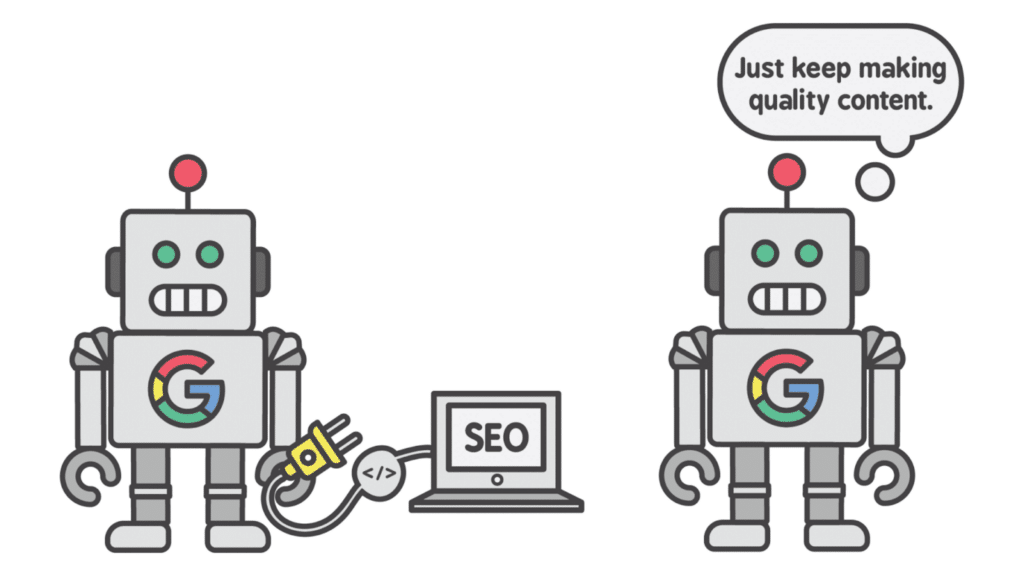
Today, we see that Google is releasing frequent broad core updates aimed at improving the algorithm from a holistic perspective. Google has clarified that for each of these updates the advice they give comes down to making great content that is high quality, expertly written, trustworthy, unique, and valuable to the user.
We suggest focusing on ensuring you’re offering the best content you can. That’s what our algorithms seek to reward.
While this advice is good, it isn’t enough. Optimizing for users over bots makes Google an ally rather than an enigma, as you both work towards the same goal: a better experience for the people behind the searches.
Enter the holistic strategy any SEO can adapt: The 6 Disciplines of SEO.

A note on our naming convention: we get that a lot of these words sound made up, but we chose to name the disciplines with a focus on the the ability derived from each. Yes, they are weird. That’s by design; weird things are easier to remember.
Here are some examples of what execution can look like within each of these disciplines.
The SEO industry has a wide and comprehensive list of recommended best practices. And, luckily, Google has provided fairly explicit guidance on what websites can do to be compliant with their guidelines. In addition, we’ve executed internal strategies which have yielded results which challenge previous assumptions and best practices.
Armed with all of this knowledge, you can make sure your site is properly aligned and thereby maximize your SEO efforts.
One client came to 97th Floor with stalled SEO efforts, despite their best efforts. Some digging during our onboarding site audit uncovered that they were unaware a manual action penalty had been placed on their site. Google Search Console revealed that structured data was being misapplied to a specific segment of the site's blog pages.
In the past, this site’s posts had included a comments section. But over time the comments became too much to moderate and they ultimately decided to disable comments for the site. In doing this, however, they forgot to disable the structured data on the backend that called out the recently disabled blog comments.
Once this was discovered, it was imperative that all of the residual structured data was removed from those pages. Doing that reassured Google that the client’s site wasn’t claiming to have something on-page that they didn’t actually have. It was a relatively easy fix, but not an obvious find for the untrained eye.
Fixes were applied. The next step was to put together a reconsideration request and submit it to Google. Once the reconsideration request was filed, the penalty was lifted within a week and the site saw significant increases in organic traffic from that point on.

Google isn’t outright about much of their algorithm. This is why the latest user-experience based algorithm update Page Experience, is getting so much attention. This update and the trends in recent updates pay particular attention to the Usability discipline, which ensures the overall SEO strategy is UX based.
Improved user experience is important to have baked into any SEO strategy from the beginning, because it has the potential to aid both your SEO-focused goals and your bottom line business goals like conversions.
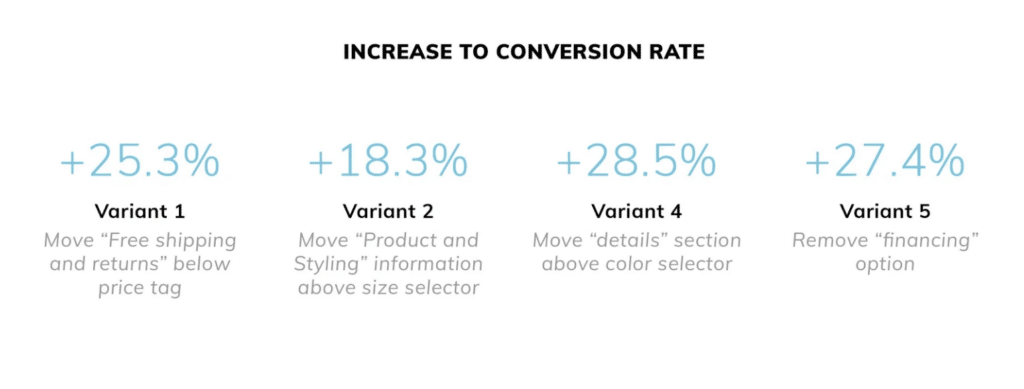
An ecommerce business came to 97th Floor with a dilemma: users were reaching their product pages, but not converting. Hypotheses were formed and ranked as to what site changes might have the greatest impact on UX, but even the most intuitive hypotheses aren’t a place to end.
Multi-variant testing showed which variations brought in the most conversions and new revenue. This was a luxury ecommerce business, even small upticks in conversion rates can show significant increases in revenue, which means they stood to gain quite a bit. In this case, almost every variant showed a positive increase in both conversions and revenue. Overall, implementing these changes led to a 29% increase in revenue over just a few weeks.
In prioritizing the usability, our client gained tangible and actionable information about what their customers like to see on their site, which in this case was removing the financing option from their checkout.
Readability in this sense refers to the ease of reading your site for bots, not humans. Readability in this sense should not be confused with user-focused readability scores that measure the sophistication and ease of reading of your copy.
Cleaning up your site’s readability can play a significant role in its ability to rank, because metadata are an important way bots analyze the content on your pages.
Improving the metadata that adorn a site’s pages is an essential way to signal to Google the relevance of the on-page content to the target focus keyword.
The most critical ways to improve readability include:
A new client approached us with hopes to increase their blog’s organic traffic. They had been blogging for years, but they weren’t seeing the traffic increases they were hoping for. An audit revealed that they were misusing H1 and H2 tags throughout their blog, at the fault of the customer template they were using. They’d chosen to use more H1 tags as H2 tags, effectively using multiple H1 tags per page. But that looked most attractive on their template, so they unknowingly were shooting their blog’s readability in the foot.
They had no idea they were defying Google’s guidelines. And while their use of H1 tags might have been easier on the eyes, it wasn’t helping them win Google’s favor. Once the H tag errors were resolved, our client saw an immediate jump in traffic. These simple readability changes brought in a golden age of SEO for their site that is still going strong.

A healthy backlink profile has always been a major part of a site’s rankability. A healthy backlink profile requires various tactics to not only increase backlinks; including branded links, anchor text distribution, link velocity, and more. Not only external links, but internal linking structure is a critical (and often overlooked) part of the linkability of a site.
Here are a couple ways you can do this:
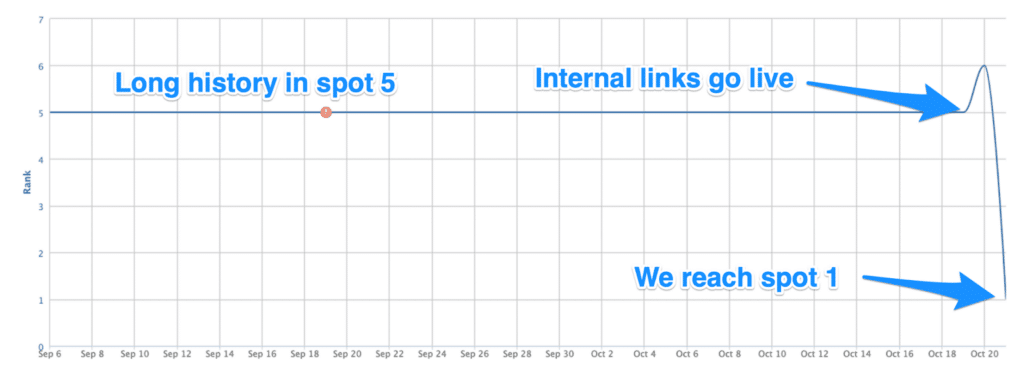
Our client was stalled ranking in position 5 on their chosen SERP, and needed to move up to gain the visibility they desired. An analysis of their site revealed they had several pages that all concerned the same topic, which can create confusion for Google. In addition, most of their pages were four links from the homepage, while few were just one or two links away.
By creating a map for Google’s bots using internal linking (using just 7 new links), the site jumped in ranking from position 5 to position 1.
This keyword had an average month search volume of 15,000 searches, which means moving from spot 5 to spot 1 generated an average of 3,300 additional clicks to the client’s webpage per month for just this keyword alone.
Indexability is how well Google is able to crawl and index a site. Google indexes sites similar to how books are indexed in a library, collecting relevant information about your site and making it easier for users to find. So, it’s in your best interest to be sure Google can easily index your site, and that it’s getting the relevant information from your site that it needs.
While readability deals exclusively with metadata, indexability is a bigger umbrella that deals with the indexability of your entire site.
If Google can’t access and process your website’s content effectively, it won’t rank your site’s URLs very well. If part of your site is unindexed or poorly indexed, Google won’t know what your website is all about. This leads to missing pages, poor rankings, and overall less traffic. Once you discover symptoms of crawlability or indexability issues on your site, you’ll need to investigate further to uncover the source.
These areas of investigation often include:
In a technical site audit for a client, we discovered some irregularities in their indexation. Further digging uncovered pages missing from the overall coverage of the site, which is a common symptom of an indexability error.
The execution of a log file analysis directed our efforts in improving indexability. The analysis revealed several actions that could be taken to fix the indexing issues the site was experiencing, including: clearing a number of redundant subfiles that Google was crawling, broken pages that needed to be redirected, and other folders Google was crawling that didn’t play a role in the overall SEO strategy.
A strategic clean up of the site’s indexability issues resulted in not only immediately more traffic, but an increase in organic revenue for our client. In the 30 days immediately following the rollout of these changes, Google organic transactions increased by 25.86%.

At 97th Floor we have about a dozen platforms to track our campaign’s performance but most commonly we use Ahrefs, Google Analytics, and Stat. You can decide what platforms and strategies are most effective for your company, however, no matter what platforms you decide to use, it’s important that you’re accurately tracking the progress of your campaigns.
The most crucial part of this data mix is making sure that the deployment and configuration of Google Analytics is not only correct but that it’s tracking the right conversions as they relate to our SEO strategy and client business goals.
Below are some ways that we do this:
You can’t make informed decisions if you aren’t tracking relevant data. Our teams consistently identify goals and values for clients in order to better track the impact of the ongoing SEO strategy in place for them.
As we continue to iterate on what is driving the most conversions to the site, we’re able to focus the strategy efforts into the parts of the site that are making the most difference for the client’s bottom line.
Holistic SEO requires visibility across the entire system. That means using tools that help teams understand how content, UX, technical performance, authority, and indexing work together.
There is no single “holistic SEO tool.” Instead, effective teams assemble a stack based on their maturity, goals, and internal capabilities.
Below are common tool categories that support holistic SEO execution:
As teams mature, the goal is not to add more tools, but to ensure the data they provide is actionable and aligned with business outcomes. Tool selection should always be driven by what decisions need to be made, not by feature checklists.
Holistic SEO is best understood in practice. The following examples show how aligning multiple disciplines leads to sustainable ranking improvements, traffic growth, and measurable business impact.
National Funding is a leading financial services company providing tailored financing solutions for small and medium-sized businesses.
The challenge
After a Google algorithm update, National Funding lost rankings for high-value keywords such as “bad credit business loans.” These rankings were critical to lead generation, and isolated fixes were not producing results.
The strategy
97th Floor implemented a holistic SEO strategy focused on restoring trust, relevance, and structural clarity across the site. This included:
The results
This systemwide approach restored and strengthened keyword visibility, leading to:
Rather than overcorrecting in one area, the holistic strategy allowed improvements to reinforce each other.
Gigamon is a network analytics vendor providing hybrid cloud infrastructure, security, and observability solutions for enterprise organizations.
The challenge
Gigamon was investing heavily in SEO but could not break into the top rankings for the highly competitive keyword “network security.” Despite doing many things right, progress had stalled.
The strategy
97th Floor took a counterintuitive, holistic approach. Instead of forcing incremental gains on the primary keyword, we:
The results
The strategy produced rapid and compounding gains:
Today, this page remains the top driver of organic traffic for Gigamon, a clear example of how holistic SEO can unlock competitive keywords by strengthening the system as a whole.
Each of these six disciplines is aimed at taking into account the various aspects of an SEO strategy. When built and executed properly, these six disciplines will positively impact the bottom line and delight your visitors.
Knowing when to reexamine each of these 6 areas of SEO will come down to knowing the symptoms of issues relating to each discipline. This goes beyond just seeing a decline in ranking or traffic. In fact, it’s knowing the specific symptoms and how to treat them that can make your SEO strategy powerful.
As you grow to understand each of these 6 realms you’ll be able to build effective. Just remember: you will get more out of strategies that are flexible and produce the greatest yields long-term.
As more time is spent mastering each of the six disciplines, your SEO strategy evolves from a collection of tactics into a cohesive system—one that compounds over time, driving lasting growth and resilience in the face of every algorithm update.
Maybe SEO was once a mysterious field, where no one but industry professionals knew exactly what went on, but no longer. In this day and age, every business needs to be informed and prioritizing SEO to truly thrive.
Oversimplified, Search Engine Optimization (SEO) is the fine-tuning of sites and pages with content and links to allow for visibility and clickability on search engine pages. But good SEO practitioners know that it’s so much more than that.
SEO marketing should be user-focused: a means of getting relevant content in front of interested people.
While most other marketing channels’ usefulness varies based on industry, it's rare indeed to find a business that wouldn’t benefit from including SEO as a key piece of their marketing strategy.
We’ve created this guide to help you understand how SEO functions in a business and how it can help drive traffic from Google to your pages and raise the bottom line of your own business.

So, how does SEO function in a business setting?
Well, first off, organic search accounts for more than half of all web traffic out there. Think of the last time you had a question about something-- chances are, you Googled it. And you’re not alone.
There are a lot of people using search engines to find the information they need online every single day, billions, in fact, but there are also a lot of sites trying to get in front of those users.
SEO in marketing is the strategy a business builds to make sure their content reaches the searchers to whom it will be most helpful and relevant.
Unlike some channels, Search Engine Optimization has the benefit of being able to meet these searches wherever they are in the marketing funnel. One big misconception about SEO is that it only focuses on top-of-funnel content, when a good SEO marketing strategy should meet the customer wherever they are in their journey.

Users often don’t follow the nice proportional funnel we’re used to talking about. Have you heard the old marketing adage that it takes encountering your brand about seven times in order to convert? The idea might be outdated, but the process of repetition certainly isn’t.
Think of your own behavior. When you made your last big purchase did you visit several different sites in your search for the most fairly priced, best quality option? Did you phrase your searches differently when you were in different stages of the funnel? Most likely your answer to these questions is a resounding yes. Most users, like you, consume what they want when they want. Their conversion journeys aren’t a straight line.
So, when they are ready to jump into research mode, for consideration or even decision stage content, you’d better hope you have pages that rank for those terms.
It’s unfortunately common to put SEO strategy in a low-priority position. Businesses might have gotten away with this ten years ago, even five years ago, but today it just won’t fly. The remarkable visibility and conversion rates possible through organic search can no longer be ignored.
Here are a few things your business can do to make SEO in marketing a higher priority today:
The first thing you can do to make SEO a priority is to decide to make it a priority. Seems simple enough, right? But it’s easier said than done. With that decision must come a commitment to see that the correct prioritization actually happens.
Vivint Solar built an enterprise by knocking doors across the US. And while they were knocking, their smaller competitors were beefing up their digital arm. Vivint Solar was losing potential customers to much smaller competitors who had a larger presence online. After recognizing the incredible potential for reaching new customers by taking advantage of high search engine traffic (specifically Google) with non-branded searches, they made the choice to prioritize SEO in marketing and began seeing immediate gains, including 6.6X increase in non-branded organic traffic.
It’s always important to have metrics, but if you aren’t choosing the right metrics to focus on, you might be overlooking significant results.
There is a mindset among marketing leaders that the proper metrics to use in measuring SEO are things like search engine traffic, links, and ranking. While there’s no question that these metrics are useful and important, you also need to track SEO in marketing with metrics like conversions and revenue that directly contribute to the bottom line and drive the business forward.
The belief that SEO can’t be measured by conversions is a misconception that needs to change.
The tactics shift with every new platform — the objective never does. This video short breaks down the game that's stayed the same since AltaVista.
Business and marketing leaders should push to keep SEOs accountable, and if that isn’t happening then SEOs should push for accountability. If the correct metrics aren’t tracked, SEOs won’t get the credit they deserve, or receive the resources they need to earn success.
In order to invest your resources efficiently, you need to know where you can make the greatest impact. That knowledge will allow you to allocate resources in a smart and successful way.
Work with the SEO specialists in your company to determine your baselines on links, content, ranking keywords, etc. and where you’re falling short of meeting your goals. Then form a strategy to tackle the places where you find your company is lacking. With this strategy in place, you will be able to make budget and hiring/vendor decisions with confidence.
There’s many reasons to hire an agency, but perhaps none is more critical than this: you want accelerated and measurable growth that doesn’t tap out your internal team.
A common misconception that companies believe is that they don’t need an agency because they already have an in-house SEO. In reality, the best clients are already doing a great job at SEO marketing, but are finding that one person (or just a few people) can’t build a castle on their own.

Hiring an agency allows businesses to work with an entire team of SEO professionals without accruing the cost of hiring their own.
When vetting agencies be sure to ask them the following:
Many believe that SEO starts with keyword research. And true, keyword research is a foundational step, but before keyword research is effective, you’ll need audience insights. Marketing leaders and SEO need to know who they are trying to reach. This is where personas come in.
Collecting demographic and psychographic information is a great place to begin, but creating a concrete story for your personas is essential in getting to know who your ideal customers are and why they act the way they do.
Once you know who your customers are, you need to know where they are. Look at the assisted conversion funnel to see where your customers are landing, and analyze what you can do to elevate these pages better within the SERPs.
Now that you know who your customers are, and where they are, look at their unique needs and how your product/service solves those needs. Figure out how you can meet their needs online in a way that outshines anything your competitors currently offer.
Further optimize by examining your highest converting pages and determine how you can help those types of pages make it in front of more customers.
It’s a common misconception that SEO work can rank an entire site. Of course, well-ranking pages will organically increase user access to the rest of your site, but it is pages that rank in SERPs, not sites.
Don’t forget this when formulating your keyword-driven content strategy. Be tactical when creating or optimizing pages by pairing them to the keywords that you want to rank for. Strive to know your target keywords (and their matching personas) like the back of your hand.
Optimize your site by keeping consistency between pages, easy internal navigation, and user-friendly design. When the internal flow of a site works well, customers will have a greater ease of conversion.
Every seasoned SEO knows that link acquisition is a necessary part of any holistic SEO strategy. Many believe that link-building is only necessary for weak and non authoritative websites, but this is simply not true. I’ve worked with many large brands who erroneously believe that link-building don’t need to be included in the SEO strategy because they think that their reputation alone will carry their success. Remember what we learned above? Search engines rank pages, not entire sites. Great content, on powerful sites, may require a few extra links to get it off to a good start.

And not all links come from outside your site. Internal links are a valuable part of using your own authority to strengthen new or striking distance content. Make no mistake, link-building should be part of any SEO campaign.
Frequent SEO reporting on metrics that affect the bottom line is critical. Metrics such as ranking and search engine traffic are important too, but also be sure you can track your SEO efforts directly to conversions and revenue.
Maximize your efforts by not isolating SEO in it’s own department. Without seamless interaction between content, web development, and other marketing channels, SEO won’t be as effective. The best SEO teams and agencies integrate their departments because it can influence so many disciplines.
SEO in marketing is a vital part of any business strategy. Because SEO is so important, especially in current times, businesses would do well to respect what SEO can do. It’s time to see marketing leaders fight for SEO resources, and align their SEO metrics to hold teams accountable for driving business success, not just traffic.
MozCon 2020 is a wrap.
We heard from many speakers covering many industries, but even more compelling than the voices we heard, was the common themes between them.
I worked with my fellow attendees from 97th Floor to pull together the common themes and action items from MozCon 2020. In no particular order, here's the themes we saw, and what marketers and brands should be doing next.

As always Moz leads by example when discussing difficult, but necessary, topics. Like addressing the current economic, social, and civil situations. Sarah Bird kicked the conference off by acknowledging the current environment, and Dr. Pete gave a heartfelt opening to his address on keyword research. Immediately Dr. Pete had my heart and attention as he drew the connection between today's circumstances and how these factor into the fundamentals of SEO. Specifically topical research.
Of course today's economic climate is affecting each of the businesses we work for. Wil Reynolds closed the conference by introducing us to the new CMO, or rather, the lack thereof. We were all given stark evidence that our careers and success as marketers hinge on being able to effectively communicate in the language of the board.

The Takeaway: I think I speak for everyone when I say I’m sick of hearing “unprecedented times” in brand messaging. Let’s skip getting things back to normal and instead make things better. No doubt, the past few months have changed some foundational elements of everyone’s lives, but as marketers let’s make sure this change is for good, and is long lasting.
Look at your current marketing efforts and ask, "Are we trying to get back to "normal"? Or are we using this as an opportunity to get better?
I think I speak for all the attendees when I say that day 2 of MozCon 2020 was filled with equal parts intrigue and trepidation. Of course we've all known for a long time 97th Floor has already believed in the power of unconventional data sets for practical SEO use. (We're so close to launching something big around this, stay tuned!)
I think most SEOs understand and respect the different methods of deep technical SEO, but many don't know what's possible, or how to begin. Enter Moz's Senior SEO Scientist Britney Muller, who walk gave every attendee the chance to dip their toes into machine learning and automaton.

Britney continued on with examples and uses cases, but perhaps none was more interesting than entities from Google. Essentially it's a score that indicates Google's topical associations with a given URL. I'm excited to dig deeper into this later.
Of course every attendee this year remembers Michael King's one of a kind theatrical experience showcasing the many use cases of data scraping, machine learning, big data crunching, and artificial intelligence.

This address was maybe the heaviest conference address I've ever heard, but the format of a ~30 minute film and story made it actually digestible. In the traditional setting, my eyes may have glazed, but today, they were glued. Today, we witnessed a new medium for virtual conference addresses. Well done Michael!

The Takeaway: The technical inspiration shared today could come across as fiercely intimidating. But you can take it for a fact that these advanced scripts, and machine learning setups aren't conceived out of nothing (even for the pros). If you are enthralled by the idea to get busy with scripts, machine learning, and automations start slow and be patient with yourself. It's a brave new world! Also rewatch those sessions when the recordings come out.
Stay glued to the 97th Floor social accounts and newsletter to be of the first to know when we drop our own software that accomplishes a lot of the technical crunching we've seen seen at MozCon.
How can you get customers if you don't know them? Even before Coronavirus, the industry has been seeing subtle shifts to growth-driven marketing. Or in other words, measurable marketing.
Quickly Wil Reynolds had the audience's attention with the line, "The less you understand your customer, the more you spend to acquire them."

If we really care about bottom line budgets, we should start acting like it. Wil went on to call out mistakes he's seen of advertisers spending inefficiently because they didn't have their customer map dialed in. He made the case that saving money comes when you understand the customer journey and all marketing facets work in unison to perfect the customer journey experience.

Branding expert Flavilla Fongang uncovered timeless branding expertise with many notable tactics like:

But perhaps none was more resounding to me than her declaration that customer engagement is a company-wide effort. Innovation must be built into the company culture to retain and delight customers.
The Takeaway: The customer journey is not only knowing your audience, it's anticipating their next move. The customer journey is crucial to bottom-line success. There are too many options in your space for you to just meet needs, we need to exceed customer expectations. And that only comes when we know our audience.
Invest in a real customer journey map (not just audience insights), paired with your published content. Hopefully you find gaps in the journey, filling those gaps with customer-focused content is your next homework assignment.
A great place to start on this a guide we put together on building a bullet-proof buyer persona.
I love transparency, but even more I love the vulnerability that took place at MozCon 2020. Speakers were eager to share what didn’t work for them. Phil Nottingham shared a story of setting three different budgets for a set video ads, $1,000, $10,000, and $100,000.
Obviously this would mean huge differences in the production value of these campaigns, and you might think that a better video ad would lead to better traffic.

Crazy right?
But we learned that spending more doesn’t mean it’ll produce proportionally more results.
Shannon McGuirk also spared no punches in reviewing her past work in link acquisition. I love this honesty, because this is how we (as a community) go further. Link acquisition is something that most are shy to share, so I was especially glad to see Shannon’s blunt honesty about what didn’t work (and what did).

The above graphic from Shannon shows what our marketing efforts tend to look like. You can see that majority of the activity is bringing in steady results. We can all see this is a healthy balance of activity, yet too often marketers only focus on the "huge wins" and consider everything else a fail. Embrace the steady performing campaigns and learn from your fails.
The Takeaway: None of us have ever marketed through a global pandemic before (unless someone at MozCon 2020 was marketing during the Spanish Flu 100 years ago). Let’s grant ourselves a little leeway and break a few eggs while we make a marketing omelet in this new world.
So don't shy away from getting after something our of your comfort zone. Whether you win or lose, the world keeps spinning. So get after that crazy idea you've been pushing off.
You know that building and selling to an audience isn’t cheap. You didn’t need to pay for a MozCon ticket to hear that, but it’s important to be reminded that people aren’t waiting around online for a brand to win their loyalty. Phil Nottingham encapsulated this feeling when he said, “The number of impressions is not the number of people impressed.”

A number of speakers today expressed renewed focus on audience building, especially through the lens of the unique health, economic, social, and civil circumstances everyone is facing today.
The Takeaway: Be empathetic and understanding with your audience. Rerun your keyword research because volumes and interests have changed dramatically in the past few months. Being quick on an SEO/paid media/content strategy for up and coming keywords in your space will be rewarded with more traffic. Now comes the fun part of turning that traffic into an audience, which was discussed today by many presenters.
Get fresh keyword and audience data, then restructure your traffic and audience source.
This isn’t a new topic for MozCon, or any digital conference for that matter, but today it matters more than it did in the past. Just within the past several months, spending and consuming habits have changed dramatically. If SEOs are working purely off keyword data that is 6-12 months old, they are missing out on huge opportunities.
Utilizing Google Trends at this time is a great place to start, and Dr. Pete took us on a journey of just how to grab that data. Who else was excited to learn about Pinterest Trends?

Many others at MozCon shared truly cool ways to collect and crunch data that give you deep and actionable understanding your audience, for example...

And don't write off knowing your own business. Heather Physioc laid down the foundational truth that before any significant marketing can be conducted, we need to understand the brand we are marketing for. Including our values and competitive edge. A good tip for defining your competitive edge is finding the collection of words that describe your businesses that end in "est" (i.e. quickest, cheapest, etc.).

The Takeaway: Your audience, along with their wants and needs, has likely drastically shifted over the last six months. If you aren't on top of those new insights, you are bleeding money. Lucky for you, there’s data out there to inform your audience strategy. Of course there’s some readily available data sources from traditional tools, but through custom scrapers and unique data pulls/crunches you can get clean data that actually informs strategy.
Make every effort to obtain audience data, build real personas, and then use those personas throughout your marketing team.
Another way to say this is to invest in your brand.
This is another trend that isn’t exclusive to this MozCon, but we’ve been saying the same thing for years. However, I think most brands are feeling this exaggerated effect given the economic hardships associated with the Coronavirus pandemic.
It was mentioned multiple times by many speakers; Capture and delight your audience, and then nurture them on your own platforms. Be it your copy, website, videos, or email.
Phil Nottingham gave a great example of this such as Uber creating Uber Presents, or Mailchimp creating Mailchimp Presents, or Wistia creating Brandwagon, a late night style talk show for marketers.

All of these projects are great examples of companies creating content for their audience. They become the media their users seek, rather than spending a ton of money to annoy users on other media platforms.
When Brian Dean started by dropping some Star Wars themed slides, he had me. But the data kept me! For example he confirmed what many have already assumed, but not with the hard data behind it. Your email subscribers are more likely to get to your content than your social followers.
 Not to mention Brian's presentation also discussed specifics of how to invest in your brand. He asserts (and I agree) that marketers need to spend more time on the promotion of their content, especially when compared to how much time we spend creating it. He called for an end to the "
One of the not-so-secret secrets to successful marketing is knowing your audience. Arguably the best way to do this is to create buyer personas.
When we onboard new clients at 97th Floor we always ask for their existing personas, and they often shrug their shoulders and rifle aimlessly through some papers. “I think we had some made about a year or two ago,” they say. But in this age of smart digital marketing, that just won’t fly. The world needs more personas-- and better personas. We at 97th Floor have the expertise, and we’re here to make the internet a better place. So we put this guide together to help you build personas for your business that will bring in consumer insights that will elevate all of your marketing efforts and increase your revenue.
Having a good buyer persona is like having your ideal customer sit next to you while you planned their content campaign. They could remind you of what’s going on in their lives and how that might affect their connection with your ads, blog posts, social media efforts, and emails.
A buyer persona is a fictional depiction of an ideal, individual customer. Creating and applying a buyer persona helps marketers craft campaigns that feel more true and have more impact. A good buyer persona can turbocharge the understanding of your customers, leading to more traffic, higher conversions, and eventually, bigger revenue figures. Who doesn’t want that? So here’s how to make it happen.
The ingredients are simple, and the process is not rocket science. Like baking bread, you already own most ingredients—flour, water, yeast, salt—and the things you don’t already have in your cupboard are easily accessible.

Begin with a little market research. What data do you already have about your customers? What are their current job titles, responsibilities, interests? If you can, use a tool like SparkToro to find out more about what your customers care about. Ask: why would they benefit from your brand? What are their pain points and how does your offer solve them? The more research you can do, the better.
Then add a little speculation. If your persona loves running, you can assume they’ll care about running form or proper running shoes. If they’re a busy mom, you can assume they’re looking for ways to relax and save time. Some assumptions are okay, and even needed, but be sure you don’t get off track.
Once you flesh out your customer with a few assumptions, mix your research and speculation together with a knowledge of the user journey for your product or service. For instance, how do they come in contact with your brand? Will they be eager to buy or will they need a little persuasion? What appeals to them on your site?
Finally, sprinkle a little creativity on top. This is the fun part: make it a story. Be as specific as you possibly can. What is their name? What do they look like? How does an average day in their life flow? Don’t be shy, write it out. Use your imagination. The end result should be fun, spunky, realistic, and easy to remember.
In baking bread, you simply put the dough in an oven. For personas, however, you need something much more rare: objectivity. A good persona requires you to set aside what you think you know about your customers and to see what the data tells you. This is very, very difficult for most businesses, which is why it makes sense to ask someone else to do it for you. When it comes to paying someone to create a customer persona for you, the greater the objectivity, the more you will pay. Spend less, and you will have a few assumptions mixed in with your objective assessments.
However, assumptions, especially when used in the less-critical and less-controversial parts of the buyer persona, are likely a good trade off for many businesses. Not everyone needs to spend $50,000 to get something truly useful.
The personas that we build for our clients at 97th Floor are a mix of strategic assumption and objective research. We are intentional in our approach choosing where we can assume and where to use data. It might not be the right approach for every business, but it’s appropriate for most businesses most of the time.
There are three major parts to buyer personas:
As you might presume, demographic information tells us the external details about the persona. This describes the age, gender, racial identity, socio-economic details, family status, occupation, and such. We glean it from a number of sources: existing customer profiles, analytics data, competitive analyses, etc. We use whatever we can get our hands on.
When we build our personas we use a balance of assumption and evidence. Our stance is that in this area, the information that we infer is good enough for the purpose and the potential mistakes are low-impact ones. But don’t get me wrong, you shouldn’t go wild with assumptions here.
There isn’t much value in knowing that your average age customer is 37 rather than 39 or 40. But there is a significant difference in an average age of 30 instead of 45. Be careful that you have enough evidence for the correct ballpark. But don’t waste resources digging into teeny specifics if they aren’t likely to be impactful.
Remember that a buyer persona is different from a target audience. This is not a broad composite, but a fictionalized specific individual. There is value in having a target audience in mind--in knowing a range that describes the whole of your customers--but the value of a buyer persona is to clearly envision one perfect client.
The demographic information describes the external details of the individual, while the psychographic information describes her internal life. We want to know what she likes and dislikes, what makes her excited or nervous, what she reads and who she follows. This is the information that a savvy marketer will prize.
We obtain this through research into tens of thousands of individuals’ web habits. With this information, we can better predict the specific behaviors and biases of a likely customer, but also general principles that describe a lot of people. There are tools out there that will help you to accomplish this task with some confidence--just don’t forget the critical role of objectivity here. We’ve seen clients with personas that only really describe the client themselves. It’s an awkward conversation, “Since you’re just launching Bob’s Widgets, is it realistic that your persona is already a member of the Bob’s Widgets Fan Club?”
When you get the psychographic profile right, it’s almost magic. For example, our research might uncover that people who like your brand also are fans of the Chicago Bulls or the Los Angeles Dodgers. It is probably too specific to know which particular team that they root for, but it is useful to know that your audience are sports fans (as opposed to, say, fans of quilting or politics or tattoos).
Many clients we onboard don’t have personas (or have only target audience information). Others have spent tens of thousands of dollars from specialists to get personas built. These expensive ones are often very slick, visually stunning, but a little impractical. While there is a lot of good stuff in these large personas, the mental strain to use them—and to tell what is most important—is too much. So we developed a convenient method that uses our inherent human neurological strengths to make it memorable.
We tell a story.
Maybe our stories aren’t on par with Shakespeare, but we are not doing this to scratch a creative itch. We are doing this because as humans we remember stories. We also remember songs, but that seemed like a little too much. So we’ve chosen to always tell a story about our persona.
There is no new information in the story. All the data we use for the story is already covered in the demographic and psychographic sections. But when we craft it into a couple of clear, easy-to-read paragraphs to describe the character succinctly, suddenly she is easier to understand and easier to remember. Because of that memorable image, it is easier to keep clearly in mind, and thus easier to create campaigns just for her.
Critically, when we tell a story we have more of the facts in easily accessible memory. Without personas, marketers will create campaigns crafted for one or two of the most obvious customer characteristics, and they generally fall pretty flat. They’re not much better than target audience descriptions. But a good story to anchor our memory allows us to retain a fuller picture of the individual. In turn, our campaigns therefore have more depth, fullness, and richness.They are, simply, more effective campaigns.
Perhaps an illustration would be useful here. Below is a story from a buyer persona that 97th Floor made for a fitness company with unique offering for choosing your goal weight:
Sharon just had her 45th birthday and it wasn’t the happiest day. She felt like everyone there was staring at her thinking of how much weight she’d gained since her second baby was born ten years ago.
She tried to diet and exercise, but her goal seemed so distant. Plus, was it even realistic for her to lose 50 pounds when she barely had time to pee alone before one of her hungry kids found her? She wanted more direction, maybe from a personal trainer or dietician, about what her goal weight should be. But they were so expensive.
She’d tried doing her own research about her BMI and ideal weight. But those gave her wide ranges or goal weights that seemed impossible.
Do you see how this little clip from Sharon’s life makes her a tangible woman? We feel her discomfort at the party. We understand why she is the perfect customer for this fitness company. We even get excited to find marketing strategies that will help Sharon find our client’s company and feel empowered on her next birthday.
Personas that hang around in a company’s back pocket unused aren’t doing anyone any good. A successful buyer persona is one that gets frequently referenced and utilized. The team has read it, talked about it, and knows it. They know that fictionalized individual as well as they know each other. She feels real to them.
Not only should these personas feel real to your team. You should lean on them during planning and writing content. For instance, as you're sitting down to plan out Q2’s content, turn to your personas. Mention, “Taylor (your persona) has young children. During Q2 those children will start summer break. How might that affect the kind of content she wants to access during that time? How might it affect how much time she has to engage?” Use the persona’s name. There’s power in shared vocabulary. Of course “Taylor” won't mean much to those outside this team, but your marketing team should be using your persona’s names. Use the personas to tap into the daily life of your content consumers, and they will feel a more realistic connection to your company.
All of this work might seem like the buyer persona is creating extra work: compressing data into a single point, and then it has to be expanded again when doing the actual marketing. The magic of the buyer persona is that it enables, and even encourages, the marketer to work at an individual level but to have that function at a broad scope. The compress-decompress that the buyer persona facilitates will hone the edge of the campaign. In practice, if it’s done right, it can feel like a superpower.
We create personas for clients as a service, or we upgrade existing ones, but personas are only the launching pad into the deep pool of consumer-facing work. Here are a few examples of great client work powered by a marketing team that understands its audience using the processes we describe above.
eFileCabinet came to us with a goal of increasing their brand visibility. In a fairly stagnant industry, their cutting-edge technology had a hard time gaining the excitement it deserved. Our team came together to define who eFileCabinet’s customers were. Like most businesses, they required multiple personas, but one particularly useful buyer persona portrayed an accountant who was frustrated with endless paper filing and tedious office chores.
Sure, this persona is an accountant, but he was far from boring.
We looked closely at what human emotions and pain points he faced, as well as ways he might enjoy letting off steam. The answer: taking a hammer to the often-frustrating office equipment he sits in front of every day. Enter: the Rage Cage.
So they could live the Office Space dream, our team crafted an experience for an accounting conference that would give them what they really wanted — the chance to smash old office equipment. Then we connected with these individuals to introduce them to the benefits of eFileCabinet’s problem-solving, headache-reducing software. This became an award-winning campaign that brought eFileCabinet the highest influx of MQLs in a single month and 100+ closed deals. None of this would have been possible without concrete, memorable, human buyer personas.
One 97th Floor client, a data service company called Qubole, was facing a long sales cycle that they were eager to tighten. We knew that buyer personas would undoubtedly help Qubole target the most promising potential customers. So we took a closer look at Qubole’s ideal buyers and got to work.
We created a persona who was a data scientist at a growing tech business that needed to scale quickly. We got to know his pain points with bringing on a data company—including security and IT complications. Knowing this information we created a hyper-focused content strategy that was built with him in mind.
With the help of this persona sitting in the driver’s seat of our newly targeted content strategy, Qubole’s traffic and conversions skyrocketed. In fact, 97th Floor's strategy led to a 600% increase in organic traffic and a 300% increase in qualified organic leads. In addition to chopping their buyer’s cycle from 240 days to only 90 days.
As with most NBA teams, the Utah Jazz found themselves struggling to sell their summer season ticket. They came to us with a desire to increase their summer ticket sales and maybe, just maybe, they’d be able to do something never done before: sell out the entire lower bowl for the summer season. As always, we began with the audience and personas.
Because we are from Utah, we knew what a typical Utah Jazz fan looks like, and so we had a good understanding of the audience to begin with. The final version of our persona consisted partially of what we knew from the standard Jazz fan and was merged with the data we had collected about folks who buy low-cost items (like summer season tickets) via Facebook Ads. Once we had our more specific persona, building the campaigns in Facebook Ads came very naturally.
First, we fanned out our ads’ reach to a wide audience of Jazz fans on Facebook. Then, we conducted tests to see which ads were the most effective at increasing sales (this information even informed our personas to make them better for the next round). We found that segmentation, even to a non-Utah Jazz audience, and sales-focused ad copy brought in a positive ROAS, a great achievement for the low budget of their summer season marketing. Our knowledge of the buyer personas of these summer customers gave the Utah Jazz an increase in ticket sales by over 300% MoM.
As these examples show, personas are not reserved for folks in content marketing roles. Entire teams from SEOs to paid media specialists to well, everyone, should be well versed in your buyer personas because a good persona will have insights that influence every decision from every member of a marketing team.
