Citations and mentions are the closest thing AI search has to a ranking. That's exactly the problem. The instinct is to treat them like the old ranking report — log it, chart it, celebrate when it climbs.
That instinct is wrong. Not because citations don't matter, but because counting them tells you almost nothing about whether being cited did anything for you.
A Quick Definition, Then the Part That Matters
A citation, as Mike Witham, our Head of SEO, defines it, is "anytime a link is in place in a generative response, whether that's hyperlinked and actual text of the response or it's linked as a source, a cited source for the response."
Two kinds are worth tracking separately. An owned citation links back to your own domain. A third-party citation is when your brand shows up inside someone else's cited content, on a domain you don't control. Both count. Only one is inside your control.
We've covered the mechanics of tracking both, plus how citations differ from brand mentions, in What to Track in AI Search. This piece is about the harder question: what are you supposed to do with the number once you have it?
Citations Are a Means, Not an End
Should citation volume be a KPI? "With like everything in marketing it's 'it depends,'" says Alyssa Felix, Search Marketer. "We shouldn't be out there like, let's just get citations on everything, kind of like back in the days in SEO when you could put the word sunflower on your site fifty million times and rank for it. All citations should have to actually do with things that matter."
Citations are a means. The end is influence.
Traditional SEO trained us to chase traffic, but traffic was always a proxy for something else: educating and convincing a buyer. AI search skips the middle step. So the question isn't how often you show up. It's whether showing up changed anyone's mind.
Where Citations Belong in the Funnel
Top-of-funnel citations are educational. Their job is to prove to a model that your brand is authoritative enough to source from in the first place.
Bottom-funnel citations, on decision-oriented prompts, behave much more like referral traffic. That's where being cited actually moves someone to click through and act.
This distinction showed up clearly on a recent account. "We noticed that all of their top of funnel prompts, they were not showing up, no competitors were showing up in terms of brand mentions," Blake Nielson, Head of Accounts said. "What we noticed was that virtually all of the citations in these top of funnel prompts were competitor citations."
The read wasn't that top-of-funnel citations don't matter. It was the opposite: this prompt set needed more top-of-funnel citation share before brand mentions could follow.
The Money Combo
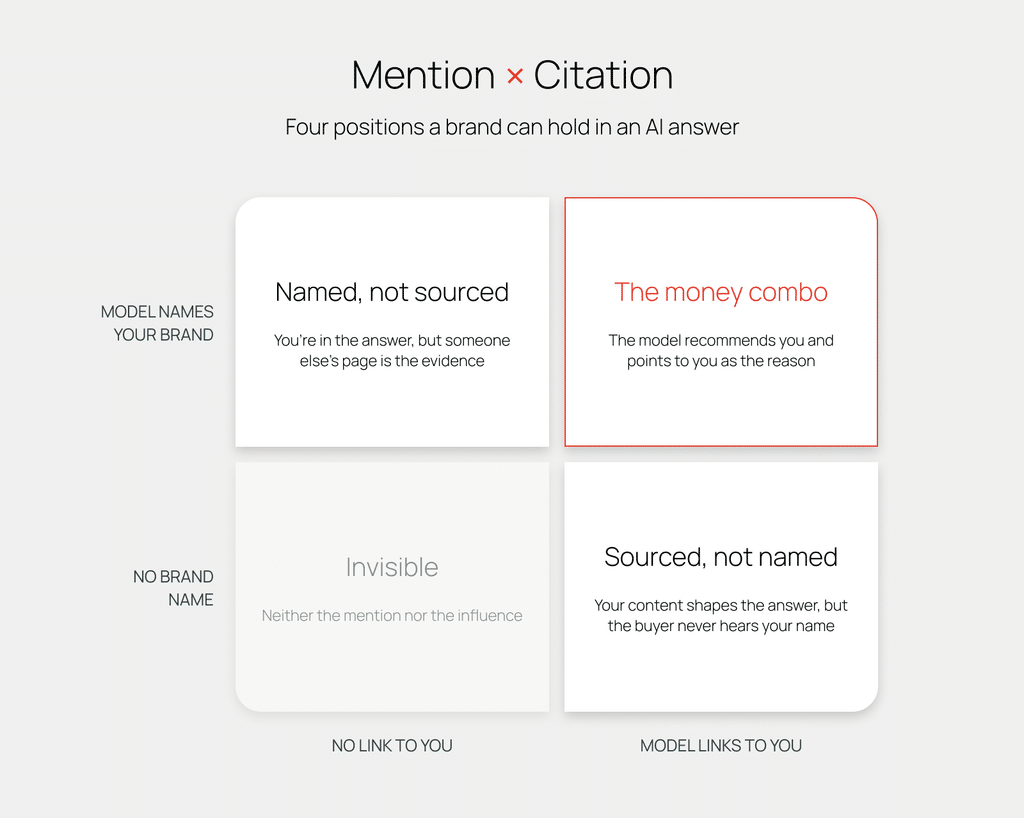
When a brand owns both the mention and the citation on a given prompt, Mike calls it the money combo — the strongest position you can put a brand in. The model names you, and it points to you as the reason.
Even without the mention, a citation on its own still does work. It signals credibility to the model and to the person reading the answer.
How You Actually Earn Them
"In its most simple form, be the answer to the questions in your content," Mike says. "In a more complicated form, you have to be able to prove to an LLM that your entity, your brand, matches what's being asked and is directly connected to a topic."
That proof gets built through networks of content — call it topic clusters, hub and spoke, content pillars, or entity mapping into a knowledge graph — backed by unique data and a technically clean, crawlable site. It's the same discipline we walk through in our guide to optimizing content for generative AI.
Third-Party Citations Mean Breaking the Silos
Earning citations beyond your own site means giving up the idea that SEO lives in a website bubble. It takes PR, paid, editorial, and social working together, so that what lives on a brand's site also exists — from a different angle, in a different voice — on reputable external publications.
"The goal of a bot when it goes out to fetch information is to get as much information about a subject as possible and then come to a consensus, an aggregate, that it delivers back to the user," Mike explains. "If your brand is across the web, mentioned in connection with a topic you want to be known for, that is going to influence the LLM."
Sentiment Is the Real Scorecard
Sentiment isn't a binary read on whether a brand looks good or bad. The real question, per Blake, is "is your brand being represented correctly? Not just visible, but correctly across the LLMs."
That reframes everything above it. The content structure, the technical setup, the external mentions built through other teams — all of it exists to shape a narrative. Citation count is just one input into whether that narrative is yours.
Which Is Why the Reddit Panic Missed the Point
When ChatGPT rolled out its 5.6 model, Reddit's citations in ChatGPT Search fell roughly 86% in four days, and the industry's reaction was immediate: Reddit is dead as a strategy, abandon ship. We wrote about why that read was wrong — the short version is that ChatGPT still appears to pull from Reddit, it just stopped showing its work. Losing a visible citation is not the same as losing influence over the answer.
Audience First, Platform Second
Here's the part worth carrying forward. That shift wasn't universal — it was specific to one model. Google's AI Overviews remain by far the largest AI search surface, and they're still citing Reddit and YouTube heavily.
So being audience first now means tracking two things, not one: which prompts matter to your buyers, and which models your buyers actually use. Presence is only worth building on the surfaces where your audience is actually asking questions.
Citations were never the finish line. They're one input into a bigger goal: making sure the story a model tells about your brand matches the one you want told.
Want to know what the models are currently saying about you — and whether it's accurate? Let's talk.