



Marketers have a lot going on in 2025.
Marketing budgets are at an all-time low post-pandemic. At companies feeling especially strained, what little budget remains is controlled by a CFO whose concern is for immediate ROI instead of long-term strategy.

Search is undergoing its own metamorphosis as AI continues to dominate SERP results and Google pushes out more algorithm changes than ever before. Gartner predicts that search engine volume will drop 25% by 2026 as audiences turn to AI chatbots and social platforms for information.

To sum up, marketers are expected to do more with less budget, grow at the whims of Google, and learn how to use AI while also combatting AI.
The response to the chaos is to focus on the core tenets of marketing–aligning our messaging to the audience and our CTAs to a robust full-funnel strategy.
Brands that will reach their audience across the entire funnel know that a message is more important than the channel through which it is sent.
Dollar Shave Club (DSC) came onto the scene in 2011 with a pioneering direct-to-consumer subscription model for high-quality razors delivered monthly for just a few bucks. The startup's messaging positioned themselves as the long-sought-for alternative to overpriced razors loaded with gimmicky features. DSC was scrappy, smart and spoke directly to their audience’s desire to save money.
Unilever bought DSC in 2016 for $1 billion cash, surely with intentions to turn the brand into a profit machine. But Unilever misunderstood DSC’s audience.
DSC was cool precisely because it wasn’t part of a massive conglomerate. Its audience loved a rugged brand born out of a viral YouTube video that offered them an alternative to $35 shaving kits.

But all that Unilever could see was the sexy world of commercials. In 2019 Unilever produced a new video for their brand DSC, inviting men and women of all kinds to “join the club.” Actually, Unilever made a slew of commercials with the same deadpan style as the 2011 hit that made DSC go viral. But it wasn’t shirtless bodybuilders squeezing shampoo bottles or sphynx cats in a shave butter heaven that made DSC successful. Okay, well kind of.
DSC subscribers love funny videos. But if the funny video doesn't have the right messaging, it still misses the mark. Unilever was too focused on channels to really understand the audience and message that DSC customers were so fanatical about.
In an effort to maintain profit margins in retail, Unilever expanded DSC’s offerings to include products such as hair cream, cologne, face moisturizer, and sunscreen. But these products cost anywhere from $10-50.
The same customer that wants quality razors for just a few bucks isn’t going to spring for a $50 bottle of cologne.
In 2023 Unilever sold their majority stake in DSC after seven fumbling years trying to grow their profit margins.
Don’t be Unilever. Know your audience. Listen to them. Create messaging that speaks to their core desires and don’t be distracted by flashy new channels.
That last part is the trap. "Flashy new channels" are usually demand channels in their prime — which means they're also the channels that will plateau, saturate, and eventually stop delivering. Udi Ledergor, former CMO at Gong, warns that every demand channel has a lifespan, and brands that build their entire growth engine on today's working channel are building on borrowed time. This short video captures what it looks like when a channel stops working — and what smart teams are already doing about it.
Something is happening to the marketing funnel. It’s waist? The core middle section that holds all those essential organs? Itty bitty. Hourglass. Nearly invisible for far too many brands.
Top of funnel content is fun! It’s exciting, it’s new, it’s engaging. Bottom of funnel strategy gets the bulk of the resources. “Leads leads leads,” we hear the CEO chanting as we ask for more SEO spend. And the mid-funnel? Forgotten.
Developing a strong mid-funnel strategy is the most crucial effort that marketers can make to increase engagement in 2025.
Mid-funnel content is the heavy hitter—or it should be—in helping your audience to trust you, become true experts in the solutions that can address their problem, and feel prepared to make a decision. This is where your audience wants to hang out.
B2B buyers are self-navigating their way to purchases. They’re not including sales people; they’re doing extensive research on their own. The brands that deliver robust early and mid-funnel content to these B2B buyers will win engagement and ROI.
A report published by Demand Gen reveals that B2B buyers consider the following to be characteristics of early- and mid-funnel content memorable enough to warrant a sales call:

The report also identified interactive content as important in the mid-stages of the buyer’s journey. This content can look take many forms, but respondents prefer:
Build mid-funnel content that allows your audience to do the research that they want to do anyway, but with you.
Ever read an article with a title like “Ten Motivational Quotes for a Tuesday” only to be hit with a “try our complicated SaaS platform” CTA?
All over the internet we’re seeing bottom-of-funnel CTAs slapped on top-of-funnel content. It’s jarring.
In 2025, engagement will hinge on how well marketers align their CTAs with the specific stage of the buyer’s journey.
Marketers should judge every single CTA against two factors: value and relevance.
First, a CTA should continue offering value to your audience. They should get something or learn something that continues to guide them on their journey and help them solve their problem.
Second, a CTA needs to be relevant to the content it appears with. A motivational quote article doesn’t need a CTA for a demo, but maybe a CTA for a productivity guide? That’s closer.
CTAs should mirror the knowledge and intent of your audience. Ask yourself this: if I were engaging with this content what would I want to know or do next that would get me closer to a resolution? That’s your CTA.
Successful marketing strategies employ multiple CTAs, each tailored for their audience’s specific needs at each stage in the funnel.
If marketing is undervalued, brand marketing is the poster child for it. Convincing leadership to lend a budget for top-of-funnel awareness plays can feel impossible in the face of a recession scare.
But marketers know the truth: having a strong brand protects performance dips in every other channel–especially organic and paid.
A strategic brand campaign can have massive ROI that rolls in new business for a long time after the campaign concludes.
One of the most overlooked brand channels is already built into your product. Former Slack CMO Bill Macaitis explains why every free user is quietly acting as a member of your marketing team, spreading awareness and pulling your brand into new organizations. This short video breaks down why your free users may be your most underutilized marketing asset.
Back to the earlier point about the mid-funnel, building strong mid-funnel strategies and CTAs along the full funnel mitigates some of the risk of investing in top-of-funnel brand marketing. Put in different terms, if you want the buy-in for your top-of-funnel dream campaigns, build the mid-funnel first and connect the dots for upper leadership.
A brand marketing campaign should not be a drop-off.
Create a journey. Make your upper-funnel content work for you by hooking your audience on valuable content that logically follows through a whole network of truly useful resources and touch points.
If we had published this article even a year ago it may have felt elementary. Of course we need mid-funnel and multiple CTA. Of course we need to focus on messaging that hits home with our audience!
But in 2025, it feels necessary to re-center on these core tenets of building a brand that audiences trust.
This year we're giving you the tools to succeed by digging into the strategies that top B2B leaders use to turn marketing challenges into meaningful wins. Subscribe wherever you enjoy podcasts.
On all counts, the Oil and Gas market is more volatile than most. Globally, prices fluctuate, regulations evolve, and supply and demand shift. Regionally, each market has unique dynamics, all dependent on macroeconomic variables like rising material costs and high interest rates, not to mention unique location-specific changes in supply and demand. Being a marketer in this arena demands a solid foundation in industry trends to make the smartest marketing decisions. Maintaining a clear Oil and Gas marketing strategy is the blueprint that guides every touchpoint between your brand and your potential buyers. It outlines who you’re targeting, the channels you’ll use, the messaging that resonates strongest, and the tactics needed to generate meaningful revenue.
However, most brands in Oil and Gas haven’t refreshed their marketing strategies in years. This leaves an opportunity wide open for savvy digital marketers.
We've dug deep into the most recent industry data and our own two decades of experience to provide you with a how-to guide on how to take advantage of this exponentially growing market. We’ll walk through the core components of building that strategy — from segment analysis and target market selection to developing a strong brand position that resonates in this complex landscape. We’ll also break down how to build a comprehensive marketing plan and how to leverage digital channels that drive measurable growth for Oil and Gas companies. With the right foundation, your team can stand out in a market that’s more competitive and more opportunity-rich than ever. Let's get right into it.
The oil and gas market is broken down into segments. If you haven’t yet, a good first step is to analyze each to find where your brand best fits in the flow. This allows for targeted marketing, laser-focused on which part (or parts) of the market you’re planning to win. Whether you and your team choose to focus on:
You’ll need a full understanding of each segment's needs and challenges to build the marketing strategies that place your brand in an optimal position and maximize your ROI. Each market has specific advantages and drawbacks.
Evaluate the potential ROI and align your marketing goals with the most promising markets. Choosing the target can make or break your marketing efforts. Trust us, taking the time to do the research will be the difference between a major win or a budget-crushing fail.
Customer Profiling and Targeting
Always know who you’re selling to. In the oil and gas industry, this could mean large corporations, smaller service providers, or even local governments. Carefully identify these key players and tailor your marketing efforts to meet their specific needs. It’s your job to connect as deeply as possible with your target audience. Potential customers are looking for personal connections with the brands they buy from, currently an uncommon occurrence in this market. This opens a window for you to step in and step up.
That window stays open only as long as your competitors remain comfortable. Marketer Sterling Snow calls this advantage "creating the channel" — and the brands that claim it first rarely give it up. When every player in your category is competing for the same keywords, the same trade media, and the same conference floors, the real leverage is in the channel nobody's thought to build yet. This short video captures why owning an uncrowded distribution channel — before your market wakes up — is one of the most durable advantages in B2B marketing.
Once you've identified your customers, the next step is to understand their behaviors. What drives their purchasing decisions? What are their pain points? What motivates them? What risks are they concerned about? Think about every step they’ll take on the buying journey, how they make decisions, and how you can meet their specific needs.
Once you’ve identified and worked to understand your audience, create a persona to represent your research. A clear, thought-out buyer persona will guide all your subsequent marketing efforts. Keep your persona in mind as you plan strategies and build campaigns. The more personalized and specific you are, the more likely your messaging will resonate with potential buyers. Here's an example Buyer Journey/Persona our team at 97th Floor recently created for General Kinematics.
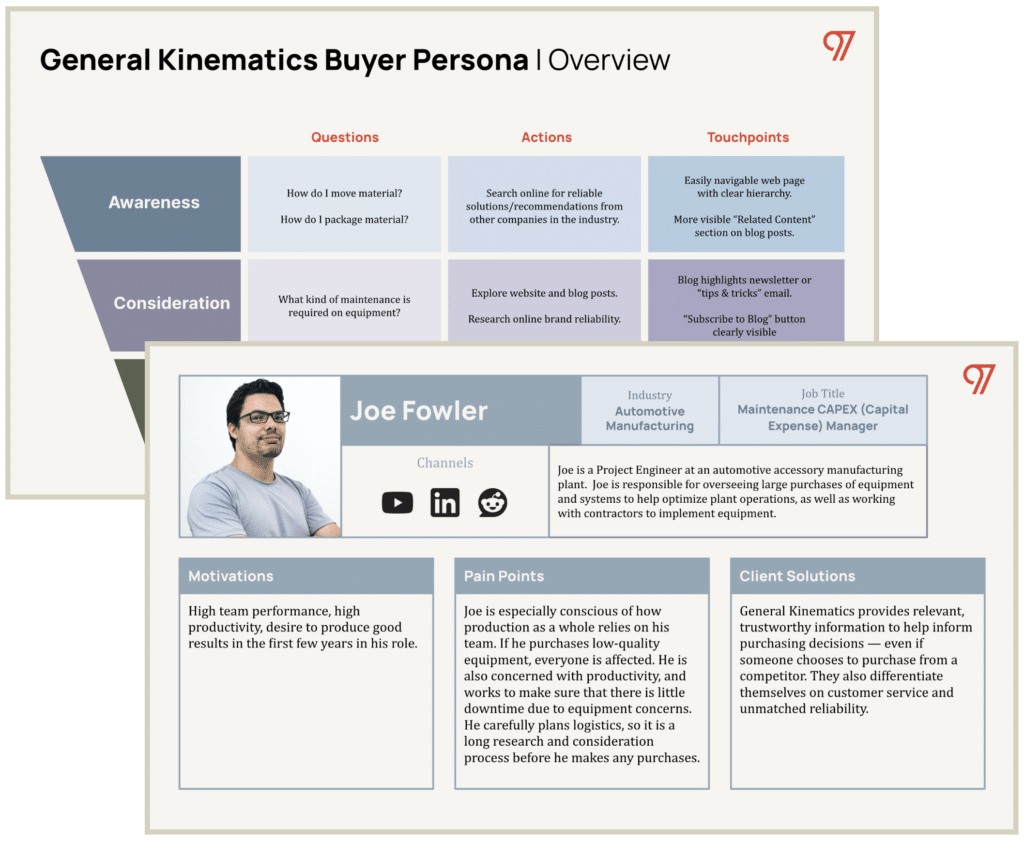
Your brand identity is what sets you apart. Think it through – what makes you different from other businesses in the industry? What are your specialized offering points? Focus on what makes your company unique, whether it's innovative technology, exceptional service, or a strong commitment to sustainability. If you’re looking for a place to start, begin by collecting reviews or interviewing previous customers for their opinions on what you do best.
With your identity in mind, work to position your brand in a way that highlights these strengths to appeal to your target audience. Clear, consistent messaging across all marketing channels is key. To pinpoint what messaging resonates best, you can give A/B testing a shot. Most importantly, always look for new opportunities to demonstrate your value through every medium. Case studies, visual data representations, and customer reviews are common ways to do this.
The battle’s not won yet, sustaining your hard-earned digital clout isn’t an easy process. Building a strong brand reputation takes time and effort. Maintain transparency, deliver on promises, and engage with your audience consistently to keep your brand's reputation positive. This needs to be an integral part of your marketing efforts.
Developing a Comprehensive Marketing Strategy
Supported by your clear brand identity and ideal customer targeting, it’s time to build out a digital marketing strategy. First, define clear, achievable marketing objectives. Whether it's increasing brand awareness, generating leads, or boosting sales, having specific goals helps measure success. Keep track of your goals and efforts to achieve them to celebrate success and identify opportunities for improvement.
A well-developed marketing strategy, especially in Oil and Gas, involves sub-strategies including
Marketers across the field agree, almost every part of digital marketing revolves around a well-optimized website. It's no different in Oil and Gas, your website is your digital storefront – the place all potential customers will navigate to on their path toward a purchase. It needs to be user-friendly, informative, and most of all, optimized for search engines to attract organic traffic. Use tools like Google Analytics, Search Console, and HubSpot CRM to track visitor behavior and optimize performance. Learn more about SEO strategies here.
Social media platforms offer a space to connect with your audience, share industry insights, and showcase your company’s culture. Regular, engaging content helps build a loyal following. Depending on your business, goals, and strategies, social media may or may not be a place to focus your budget and time.
Quality content drives traffic and builds trust. Create valuable content that addresses your audience's pain points and positions your company as an industry thought leader. Publishing content also drives your SEO. Learn more on how to set up a consistent content strategy here.
Regularly analyze your marketing efforts to measure ROI. Use analytics tools to track performance and adjust strategies as needed for continuous improvement. Keep in mind that metrics like impressions and leads can be a great start, but the end-goal of marketing is to generate conversions. Successful marketers make money. If ROI is stagnant, the marketing strategy is too.
By targeting the right segments, fine-tuning your strategies, and focusing on persona-specific messaging, you can position your brand as a leader in this digitally stagnant market. In Oil and Gas, staying ahead requires a laser focus on your goals and your audience's needs. Find ways to set yourself apart and continuously refine your strategies. With a well-crafted Oil and Gas marketing strategy, you’re ready to take advantage of the market and win contracts like never before. Good luck!
Want to kickstart your marketing dreams? We're here to help.
Locked away in a vault for nearly 150 years, the Coca-Cola formula is one of the most secretive and highly-guarded pieces of proprietary information in US company history. The only rival worth comparison is the one and only Google Search Algorithm, that great unknown that dictates the lives of SEOs determined to win rankings.
Google rarely shares how it decides what pages to show for which search queries, leaving SEOs to wrestle with the wimpy scraps of information that Google does reveal. However, scrappy SEOs have successfully reverse engineered the algorithm over the last two decades to determine the most impactful ranking factors.
But it seems that the more SEO professionals discover about how the Search Algorithm works, the more Google tries to protect their “secret formula”.
Hardly has a breakthrough graced the front page of Search Engine Journal before Google is issuing carefully worded public statements that confuse the true meaning, all in the name of protecting the algorithm.
What reasons does Google have to hold their ranking algorithm so secretive? Here are a couple to consider:
Well, last week the “vault” malfunctioned. From credible sources, there was a reported internal Google API Docs leak that shed some light for the first time on what Google considers when ranking pages for keywords. Given the history of secrecy and occasional dishonesty from Google around their algorithm, this is a really big deal! Before we jump into our biggest takeaways from this leak it's important to note a couple of things:
There is no information on a scoring system that Google uses to weight these ranking signals that were discovered in this leak. So testing is still very much necessary in determining the impact of these ranking signals.
While it is very exciting to have confirmation of long suspected ranking signals, these ranking signals still very much fall in the middle of these two categories. Without a scoring system, we do not know how important or unimportant they are without testing for a wide range of keywords.
Even though it has long been denied by Google that they use user click and interaction data as a ranking factor, ranking signals found in the leak contradict this claim. The click data metrics measure whether users found what they were looking for when they clicked on the page in the SERP or not.
Why Does it Matter?
This knowledge opens the door to increased emphasis on creating a user experience that matches what the searcher intent is. Obviously this has always been of high importance, but now we can run user experience tests and competitor analysis in the name of ranking higher for intended keywords. One example of what this could look like is testing different pricing strategies to determine if the price of our product does not match expectations, causing the user to bounce after seeing the price, and how that affects our rank on the SERP.
It's important to know that Google is a hoarder-of data. Google saves nearly everything it crawls. According to this leak, the last 20 versions of a page are considered when ranking a page.
Why Does it Matter?
We can now have a better idea of how long Google will take to understand which keywords we want to rank for when a site goes through a rebrand or re-positioning in a market.
The quality and user experience of the homepage of a site is considered every. single. time. a page is ranked by Google. We also suspect that it matters if what is found on the home page is on topic with the content on the page being considered by Google
Why Does it Matter?
The home page can be used as a way to test if Google is considering it as a significant ranking factor for a focus keyword.
The leak showed that Google attempts to find the date of a page in various places: the URL, the title or in semantics of the body text of a page. The date is then considered in rankings in order to determine the freshness of the content.
Why Does it Matter?
If a page has a date in the title or the URL, it is going to indicate to Google whether it is recent information or not. Sometimes this is not a problem, say if you are trying to rank for the keyword “best 2024 baseball bats.” However if you are trying to rank for a more evergreen keyword like “best youth baseball bat brands”, having a date in the URL may harm your ability to rank long term.
One of the pillars of great marketing at 97th Floor is Empathy. All of our marketing efforts are driven by what matters most to the audience we are marketing to. We are connecting real people who have problems that our clients can solve. Nothing about that approach will change given this data leak or any future revelations about the workings of the algorithm.
What this data leak will allow us to do is test and experiment new optimization techniques and tactics to determine what will get our clients the most visibility in front of the intended audience.
Reaching the right audience takes more than targeting — Ardath Albee, B2B content strategist and author, argues that most personalization misses the point entirely. This short video breaks down what buyer-relevant content actually looks like.
97th Floor is expert at getting results from our SEO efforts. We already know our processes drive significant results, but now we have a better understanding on enhancing those processes.
In 2022, artificial intelligence can drive cars, map the spread of infectious diseases, and recommend your next binge-worthy show. Some AI is even composing music and painting.
By some estimates, we could achieve “singularity”—or the point at which computers are proactively and exponentially improving themselves as the dominant intelligence on earth—by 2045.
Others don’t think this will ever happen. We think there’s no point worrying about it yet.
We’re wondering how it could impact marketing. Could certain marketing roles or responsibilities eventually be replaced by AI? Specifically, how will it impact content creation? With so much of a marketer’s work already living on digital platforms powered by AI (Google, social media platforms, marketing automation software, etc.), could AI-generated content ever replace human-generated content?
We wanted to know. Fortunately, our client Hiya wanted to know, too.
Hiya is a SaaS voice performance platform that reduces spam calls and provides extremely impactful caller ID services to enterprises. We fed various AI machines content prompts for Hiya and gave the exact same prompts to the content team at 97th Floor. Take the quiz to see if you can pick out the human-created content.
We took these results back to Hiya to see what they thought about the AI content. Jonah-Kai Hancock, Hiya's Vice President of Demand Generation, noted that "Any time you are asking someone to read a blog or engage in an email or watch a webinar you are asking for their time and I don’t think that the AI does a really good job explaining what I would get out of that time.”

Rachel Bascom, Head of Content Marketing at 97th Floor, was surprised by what the AI could do. She shared, “The blog article from AI may rank fairly well. We could use it for SEO and it might please an algorithm, but I don’t think it would sell anything anytime soon. A content marketer is thinking beyond an algorithm in a way that AI can’t do. Yes, the AI piece might rank well, but what happens when someone opens that link? Human writers can think about the content journey and create something engaging, educational and conversational.”
Rachel is also feeling assured that she, a living breathing content marketer, will get to keep her job after this experiment.
No surprise here—we all felt that the AI content lacked personality. Especially in Hiya’s industry where personal touch is central to their product, this AI content could never fly.
But honestly, that’s what we expected. Here’s the process most marketers face when trying AI out for the first time:
Maybe you’ve had similar experiences. AI is, most often, not where it needs to be for marketers, and many marketers feel that their existing, non-AI process for content creation is effective. To many, adding AI seems like an unnecessary disruption of that process.
Hancock shares, “It would be a lot more work for me to figure out how to make AI work. Unless my content team came to me and said ‘hey we really want this and here’s why,’ I don’t see this happening right now.”
Content-generating AI is still unproven, and marketers are justified in hesitating to invest.
But that hesitation has a compounding cost — and the gap between early movers and late adopters widens faster than most realize. Certainty is always one more data point away, and waiting for it is how capable people end up starting last. Daniel Nisan, startup founder and investor, makes the case that waiting for proof isn't caution — it's the most common reason people never begin. This short video breaks down the mental shift that separates those who start from those who wait indefinitely.
But is it possible we’re not giving AI a fair shot? It’s possible the marketing industry needs to invest more time and money into AI before it can help us to improve our content.
Realizing great AI-assisted content requires investing time into the tool.
Kate Bradley Chernis knows all about that. Chernis is the founder and CEO at Lately, an AI-based content generation platform creating dozens of pretested social posts to promote your brand’s longform content. Kate shared this with us: “If artificial intelligence was a human, it would be about three months old. It can’t sit up on its own, can’t feed itself, can’t do a lot of things. It requires human intervention to even exist. Without humans, it's just automation—we have to guide the AI along in the process.”

Laura Smous is the VP of Product Marketing at Verblio, a content creation marketplace and platform powered by human writers. We asked Laura about how writers should be using AI and she assures us that “There are a ton of places where AI can provide a really great assist, but it’s not replacing humans in the way that people fear.”
So, will AI take content marketers’ and copywriters’ jobs? Never. AI has major limitations. That said, there is no doubt it is quickly finding its way into the content production process. Marketers who don’t start experimenting and discovering the value AI can bring to their content could be disadvantaged.
Paul Roetzer, founder of the Artificial Intelligence Marketing Institute, forecasts that “A lot of marketers are going to sit back and in three years think ‘wow, this software is way better than it was.’ Then there’s going to be a segment of marketers who understand the potential of more intelligent software and they’re going to find those tools today and get a multi-year headstart on their peers who are still afraid of the topic.”

So where do marketers begin? How do marketing teams invite AI into their processes? We propose 3 key opportunities:
Market research is time-consuming and expensive—it’s also the least predictable aspect of content creation. It could take 2 hours or it could take 15 minutes. But it’s obviously crucial in providing content that resonates with your audience.
Laura Smous believes, “Content research can be assisted by AI, ensuring that some of the foundational ideas in content are not only backed by data but that they actually come from data as opposed to instinct. We can actually get some validation from AI research before anyone starts writing or looking at a brief.”

When Tomorrow Sleep appeared as a new startup in their market, their own high-quality content was pulling about 4,000 visitors per month. Anxious to scale up their content and connect with their audience, Tomorrow Sleep tapped into multiple AI-backed and non-AI-backed data content research tools. After discovering the topics their audience responded to and what their competitors were doing with these topics, Tomorrow Sleep was ready to launch new content that would rank and resonate with customers. The new AI-informed content resulted in 40,000 monthly site visitors - a 10,000% increase in less than a year.
Want more expert marketing content sent right to your inbox?
Join our newsletter and never miss a beat.
The AI didn’t write any of Tomorrow Sleep’s new content, but it propelled the marketing team in the right direction. Because of the new insights from AI, they could be completely confident in their content strategy, and their remarkable results further justified their research and content.
AI and even some of the newest data-backed tools can identify trends and keywords to focus on, generate topics, uncover what competitors are saying and identify high-value content for your audiences. It can analyze tremendous amounts of data - even open-ended data - with speed and efficiency, delivering key insights to decision makers before a decision is made.
Palomar is 97th Floor’s patent pending software for analyzing contextual, semantic data in real-time. Palomar’s SERP Intelligence crawls through all of the content on the web that competes with your content and after thorough analysis, it will not only tell you what to speak on and how to speak about it.
Another essential tool for marketers is SparkToro (founded by Rand Fishkin, original founder of Moz). SparkToro aggregates the most comprehensive overview of audience data on the internet revealing demographics, behavioral traits, topics discussed publicly online, and other key data points so that we can pick up on how our audience thinks, what they consume and ultimately how to help them purchase intelligently.
97th Floor recently took on a client facing unfounded public criticism and negative press, desperately in need of reputation management. We learned from Semantic Analysis in Palomar that a specific thought leader’s writing was negatively impacting public sentiment. We learned from SparkToro where specifically our audience was consuming this content. Our content teams knew that in order to rank on this issue and correct the misinformation, we had to debunk what was coming from these sources. Over the course of ten months, this research-backed content helped pull our client towards a positive public sentiment. Without this intelligence, our content could not have correctly identified and addressed the issues threatening our client.
AI or not, marketers are severely under-leveraging the tools and data available to them.
Do This: Let data-backed tools analyze data and deliver insights to you. Don’t shy away from this bias-free, super-efficient way to discover the seeds in your data that lead to golden content. Spend your time strategizing around reliable data, not finding it.
Tools to Try:
• SparkToro
• Palomar
• BuzzSumo
“Humans are bad at getting started. They’re bad at doing that first step towards that task.” That’s Laura Smous again and we’re all feeling quite seen by her comment. And maybe a little relieved that other humans are also like this.
Getting down an outline, a first draft, a content brief - going from nothing to something - can be daunting. But if an AI cranks out that first piece of writing for you, you can start acting as editor and creative, launching off of that writing into something more exciting without losing hours watching your cursor blink on an empty page.
The Associated Press was one of the first news organizations to use AI in reporting by integrating AI for news gathering, production and distribution beginning in 2014. By allowing AI to help draft content and amp up volume, AP reporters had more time to “experiment with new projects and establish thought leadership.”
Rachel Bascom shares, “In the past 9 years at 97th Floor, I’ve written a lot of content on a lot of different topics. Ten minutes can very quickly turn into thirty minutes or an hour when you’re just struggling to get started. Using AI-generated content as something to start with would make a huge difference.”

Where would you spend that 10 minutes? What about 30 minutes? An hour? What new projects would you start?
Do This: Add an AI draft to your workflow. Let a cold machine write something bad. Then turn that into something great.
Tools to Try:
• Frase
• Jasper
• StoryLab.ai
Yes, AI can speed up our processes—but we want more from it than efficiency. We want AI to help us create better content. There’s so much discussion about improving AI content, but could AI also teach us a few things? We posed this idea to Kate Bradley Chernis, and she shared two cases where Lately’s AI did just that.
One Lately client fed his blog into Lately’s AI and was horrified by the social posts he got back. Rather than condemning the machine for producing bad content, the client went to the Lately word cloud associated with his writing, examining which words resonate with his audiences across every timeframe, channel and campaign. He realized that his blog post was just bad. With new intel from Lately’s AI, this client rewrote a more focused blog post. The Lately social posts that came from this new content were spot on.
Gary Vaynerchuk, now one of Lately’s advisors, tested Lately by having his team create an entire Twitter channel (@garyveetv) with hours and hours of content they pumped into it. Initially, Lately’s content boosted the channel's engagement by 12,000%.
Vaynerchuk’s team also reported an 80% agreement between the quotes Lately pulled and what they would have pulled themselves. His team went back and forth with the AI, feeding Lately tons of content to learn from and then comparing their own content with whatever Lately produced for wildly successful results.
Both Lately clients consulted the AI to make sure their content was on track with their marketing goals, using each interaction as a data point to guide the content forward.
Some AI services like Grammarly can edit copy, checking for grammar, spelling and weak writing. Marketers should also consider AI that analyzes for consistency in style, tone, terminology and content goals.
Laura Smous admits that “Humans are very bad at consistency. Humans think if they have a script or a pitch that they use that they deliver it the same way every time, or that their follow-up is at the same intervals and we’re actually pretty bad at understanding if we’ve done that.”
AI can help solve this problem in your content, building coherence across all of your content so that your audience recognizes and trusts each piece you create.
Do This: Collaborate with AI. Consider the relationship symbiotic. Check back in while editing and before publishing to make sure your content is consistent, accurate and focused.
Tools to Try:
• Lately
• Acrolinx
• CrawlQ
AI models have not yet proven themselves to be a sure-fire investment of marketers’ time and money. Content AI isn’t quite where we want it to be now, but maybe that future dream of AI-assisted content collaboration is only realized by marketers who will put in a little more time and a little more money and a little more feedback. It is called machine learning, right?
Either way, marketers are not leveraging existing tools (AI and non-AI) nearly as much as they should be and the only way AI will ruin jobs is if marketers don’t begin learning how to collaborate with it.
We’re at the home stretch of 2020, and as much as we’d like to live these last few weeks in comfort, Google had other plans for SEOs. Say happy holidays to the December 2020 Core Update.
It seems like awkward timing. However it’s better than it happening one week earlier, possibly disrupting Black Friday and Cyber Monday online sales. So I suppose there was some level of kindness baked into this release.
The update appears to have begun rolling out on 1pm ET December 3rd (about two and a half hours after Google’s announcement), but it’s likely we’ll see the rollout affecting SERPs for the next week or two, as is typical with these core algorithm updates from Google. However many online, and within 97th Floor's clients have seen fluctuations happening earlier this week, possibly indicating a soft rollout earlier than the official announcement.
Granted it’s been only 24 hours since the results started rolling in, but even still, there are some trends to make note of.
First and foremost, E-A-T (expertise, authority, and trust) has come out as a prevailing set of metrics that determine a positive outcome for sites during this unforeseen update. It’s worth taking a second to remember the May 2020 Core Update, which was a larger than average update, negatively affecting many sites that were not prioritizing E-A-T. It seems that authoritative backlink profiles are a major factor, as they were in the May update.
When reading between the lines on all the forms online concerning the update, it’s possible to infer that many old-school (AKA blatant black-hat) SEOs are feeling the burn of decreased rankings and traffic right now. Much of the May 2020 Core Update also systematically penalized these kinds of sites as well, and it seems that sites that continued to avoid holistic SEO fixes are feeling the heat today.
Ever since the infamous Medic Update of August 2018, many are looking for specific industries hit by these updates, which hasn’t been the case in the same severe way the Medic update was. However, the auto industry seems to be taking more than its share of shake ups today. I would also note that legal sites (and heavily regulated industries in general) are seeing fluctuations.
As helpful as it is to hear Google say, “Our guidance about such updates remains as we’ve covered before,” I want to provide more specifics.
First and foremost, make E-A-T a priority for your site in every aspect, especially link acquisition. A number of big brands are gaining valuable ground on their SERPs, which in itself is very insightful. However, when looking at these brand’s backlink profiles, we’re seeing big link wins in the past 6 months. Double down on real link-building, the kind that passes authority, is indexed, and respected by Google. This can be done by leaning on things like guest post link building and branded link mention reclamation campaigns
Make sure you are accurately documenting your site's success or failure during this update. This update is terribly hard to diagnose with recent traffic, given that last week was a major holiday in the US. So when looking at your position, trust keyword positions over traffic for the time being.
As always, be sure to report this information to your team members and managers with a link and some screenshots from your own ranking and traffic numbers. Explain what E-A-T is and then devise an action plan of what E-A-T means for your site and brand, it will likely involve better content and links.
Reach out to me on Twitter @Joe_Robledo_ with any questions or updates.
MozCon 2020 is a wrap.
We heard from many speakers covering many industries, but even more compelling than the voices we heard, was the common themes between them.
I worked with my fellow attendees from 97th Floor to pull together the common themes and action items from MozCon 2020. In no particular order, here's the themes we saw, and what marketers and brands should be doing next.

As always Moz leads by example when discussing difficult, but necessary, topics. Like addressing the current economic, social, and civil situations. Sarah Bird kicked the conference off by acknowledging the current environment, and Dr. Pete gave a heartfelt opening to his address on keyword research. Immediately Dr. Pete had my heart and attention as he drew the connection between today's circumstances and how these factor into the fundamentals of SEO. Specifically topical research.
Of course today's economic climate is affecting each of the businesses we work for. Wil Reynolds closed the conference by introducing us to the new CMO, or rather, the lack thereof. We were all given stark evidence that our careers and success as marketers hinge on being able to effectively communicate in the language of the board.

The Takeaway: I think I speak for everyone when I say I’m sick of hearing “unprecedented times” in brand messaging. Let’s skip getting things back to normal and instead make things better. No doubt, the past few months have changed some foundational elements of everyone’s lives, but as marketers let’s make sure this change is for good, and is long lasting.
Look at your current marketing efforts and ask, "Are we trying to get back to "normal"? Or are we using this as an opportunity to get better?
I think I speak for all the attendees when I say that day 2 of MozCon 2020 was filled with equal parts intrigue and trepidation. Of course we've all known for a long time 97th Floor has already believed in the power of unconventional data sets for practical SEO use. (We're so close to launching something big around this, stay tuned!)
I think most SEOs understand and respect the different methods of deep technical SEO, but many don't know what's possible, or how to begin. Enter Moz's Senior SEO Scientist Britney Muller, who walk gave every attendee the chance to dip their toes into machine learning and automaton.

Britney continued on with examples and uses cases, but perhaps none was more interesting than entities from Google. Essentially it's a score that indicates Google's topical associations with a given URL. I'm excited to dig deeper into this later.
Of course every attendee this year remembers Michael King's one of a kind theatrical experience showcasing the many use cases of data scraping, machine learning, big data crunching, and artificial intelligence.

This address was maybe the heaviest conference address I've ever heard, but the format of a ~30 minute film and story made it actually digestible. In the traditional setting, my eyes may have glazed, but today, they were glued. Today, we witnessed a new medium for virtual conference addresses. Well done Michael!

The Takeaway: The technical inspiration shared today could come across as fiercely intimidating. But you can take it for a fact that these advanced scripts, and machine learning setups aren't conceived out of nothing (even for the pros). If you are enthralled by the idea to get busy with scripts, machine learning, and automations start slow and be patient with yourself. It's a brave new world! Also rewatch those sessions when the recordings come out.
Stay glued to the 97th Floor social accounts and newsletter to be of the first to know when we drop our own software that accomplishes a lot of the technical crunching we've seen seen at MozCon.
How can you get customers if you don't know them? Even before Coronavirus, the industry has been seeing subtle shifts to growth-driven marketing. Or in other words, measurable marketing.
Quickly Wil Reynolds had the audience's attention with the line, "The less you understand your customer, the more you spend to acquire them."

If we really care about bottom line budgets, we should start acting like it. Wil went on to call out mistakes he's seen of advertisers spending inefficiently because they didn't have their customer map dialed in. He made the case that saving money comes when you understand the customer journey and all marketing facets work in unison to perfect the customer journey experience.

Branding expert Flavilla Fongang uncovered timeless branding expertise with many notable tactics like:

But perhaps none was more resounding to me than her declaration that customer engagement is a company-wide effort. Innovation must be built into the company culture to retain and delight customers.
The Takeaway: The customer journey is not only knowing your audience, it's anticipating their next move. The customer journey is crucial to bottom-line success. There are too many options in your space for you to just meet needs, we need to exceed customer expectations. And that only comes when we know our audience.
Invest in a real customer journey map (not just audience insights), paired with your published content. Hopefully you find gaps in the journey, filling those gaps with customer-focused content is your next homework assignment.
A great place to start on this a guide we put together on building a bullet-proof buyer persona.
I love transparency, but even more I love the vulnerability that took place at MozCon 2020. Speakers were eager to share what didn’t work for them. Phil Nottingham shared a story of setting three different budgets for a set video ads, $1,000, $10,000, and $100,000.
Obviously this would mean huge differences in the production value of these campaigns, and you might think that a better video ad would lead to better traffic.

Crazy right?
But we learned that spending more doesn’t mean it’ll produce proportionally more results.
Shannon McGuirk also spared no punches in reviewing her past work in link acquisition. I love this honesty, because this is how we (as a community) go further. Link acquisition is something that most are shy to share, so I was especially glad to see Shannon’s blunt honesty about what didn’t work (and what did).

The above graphic from Shannon shows what our marketing efforts tend to look like. You can see that majority of the activity is bringing in steady results. We can all see this is a healthy balance of activity, yet too often marketers only focus on the "huge wins" and consider everything else a fail. Embrace the steady performing campaigns and learn from your fails.
The Takeaway: None of us have ever marketed through a global pandemic before (unless someone at MozCon 2020 was marketing during the Spanish Flu 100 years ago). Let’s grant ourselves a little leeway and break a few eggs while we make a marketing omelet in this new world.
So don't shy away from getting after something our of your comfort zone. Whether you win or lose, the world keeps spinning. So get after that crazy idea you've been pushing off.
You know that building and selling to an audience isn’t cheap. You didn’t need to pay for a MozCon ticket to hear that, but it’s important to be reminded that people aren’t waiting around online for a brand to win their loyalty. Phil Nottingham encapsulated this feeling when he said, “The number of impressions is not the number of people impressed.”

A number of speakers today expressed renewed focus on audience building, especially through the lens of the unique health, economic, social, and civil circumstances everyone is facing today.
The Takeaway: Be empathetic and understanding with your audience. Rerun your keyword research because volumes and interests have changed dramatically in the past few months. Being quick on an SEO/paid media/content strategy for up and coming keywords in your space will be rewarded with more traffic. Now comes the fun part of turning that traffic into an audience, which was discussed today by many presenters.
Get fresh keyword and audience data, then restructure your traffic and audience source.
This isn’t a new topic for MozCon, or any digital conference for that matter, but today it matters more than it did in the past. Just within the past several months, spending and consuming habits have changed dramatically. If SEOs are working purely off keyword data that is 6-12 months old, they are missing out on huge opportunities.
Utilizing Google Trends at this time is a great place to start, and Dr. Pete took us on a journey of just how to grab that data. Who else was excited to learn about Pinterest Trends?

Many others at MozCon shared truly cool ways to collect and crunch data that give you deep and actionable understanding your audience, for example...

And don't write off knowing your own business. Heather Physioc laid down the foundational truth that before any significant marketing can be conducted, we need to understand the brand we are marketing for. Including our values and competitive edge. A good tip for defining your competitive edge is finding the collection of words that describe your businesses that end in "est" (i.e. quickest, cheapest, etc.).

The Takeaway: Your audience, along with their wants and needs, has likely drastically shifted over the last six months. If you aren't on top of those new insights, you are bleeding money. Lucky for you, there’s data out there to inform your audience strategy. Of course there’s some readily available data sources from traditional tools, but through custom scrapers and unique data pulls/crunches you can get clean data that actually informs strategy.
Make every effort to obtain audience data, build real personas, and then use those personas throughout your marketing team.
Another way to say this is to invest in your brand.
This is another trend that isn’t exclusive to this MozCon, but we’ve been saying the same thing for years. However, I think most brands are feeling this exaggerated effect given the economic hardships associated with the Coronavirus pandemic.
It was mentioned multiple times by many speakers; Capture and delight your audience, and then nurture them on your own platforms. Be it your copy, website, videos, or email.
Phil Nottingham gave a great example of this such as Uber creating Uber Presents, or Mailchimp creating Mailchimp Presents, or Wistia creating Brandwagon, a late night style talk show for marketers.

All of these projects are great examples of companies creating content for their audience. They become the media their users seek, rather than spending a ton of money to annoy users on other media platforms.
When Brian Dean started by dropping some Star Wars themed slides, he had me. But the data kept me! For example he confirmed what many have already assumed, but not with the hard data behind it. Your email subscribers are more likely to get to your content than your social followers.
 Not to mention Brian's presentation also discussed specifics of how to invest in your brand. He asserts (and I agree) that marketers need to spend more time on the promotion of their content, especially when compared to how much time we spend creating it. He called for an end to the "
Last week, Google announced a new set of metrics that will play an integral part in the future of Google’s algorithm called, Core Web Vitals. Google is giving a whopping 6+ months head’s up for SEOs and webmasters, and it looks like we’re going to need it.
This update will not take effect until 2021.
From Google, “The ranking changes described… will not happen before next year, and we will provide at least six months notice before they’re rolled out.”
I’ll go into it in detail later on the Core Web Vitals, but they are essentially an organized set of loadability metrics Google believes contribute to positive user experience. These contribute to the encompassing term from Google, page experience, which is core to this upcoming update.

At a glance, page experience is a set of signals that measure how users interact with a web page beyond its strictly informative elements. It includes Core Web Vitals, which is a set of metrics that measure real-world user experience for loading performance, interactivity, and visual stability of the page. Once this update rolls out, Google will be combining the Core Web Vitals ranking signals with the existing Search signals of mobile-friendliness, safe-browsing, HTTPS, and intrusive interstitial guidelines in order to create a more complete and measurable picture of the user’s on-page experience.
The focus on page experience seems to be a signal from Google that holistic SEO matters more now than ever. It’s clear that content or links alone don’t determine the ranking of a given webpage, although Google has made it clear that content still plays a vital role in the future of the core algorithm.
A good page experience doesn’t override having great, relevant content. However, in cases where there are multiple pages that have similar content, page experience becomes much more important for visibility in Search.
Content still tops the list when optimizing a page or site, but it seems page experience can solve tie-breaker situations.
Core Web Vitals are encompassed within Google’s definition of page experience. At this time, it appears that three vitals will be measured when this core update launches:
Google has made it clear that this list is not set in stone, and there could be new metrics added to this group down the line. 97th Floor will continue to give updates on Core Web Vitals as more information is made known, and we have more time to test.
SEOs have long been able to use tools provided by Google like Page Speed Insights, Google Search Console, and Chrome User Experience Report. As of last week, they have each been updated with new elements pertaining to the Core Web Vitals.

Marketing leaders need to ensure that their SEOs and development team members are properly integrated to ensure the testing, and execution of these improvements take place.
The world has at least 7 months before this rolls out, but that’s no reason to sit until that time comes. Because much of what will go into page experience will require web developers to optimize, it’s critical that SEOs begin having those conversations now to ensure they have the bandwidth for technical fixes in the months to come.
Curious SEOs have already started digging into the tools provided by Google to see how their site’s fare:

Effective immediately 97th Floor is including LCP, FID, and CLS into our site audits for all clients. Of course, Google has mentioned that the effects of these fixes will not directly help sites until the update officially rolls out in 2021, but some sites could see longer runways to rollout than others, and henceforth will require ample time to execute fixes. We recommend SEOs begin utilizing their Google testing tool of choice.
For the next six months double down on content that cuts to the heart of the user’s questions. I suggest SEOs review high traffic pages and ensure that new content conveys clear messaging and gives users a reason to stay on the page.
For example, if your web page has a chart that lists out the qualifying times for the Boston Marathon, turn that into a calculator, provide graphics that illustrate training regimens, and link to your existing articles about the Boston Marathon.
One way that you can identify the pages that could use the most attention would be to hop into Google Analytics and filter down to Google / organic pages that have a session duration that is below the average session duration for your site. This list could then be sorted by the ones that have been getting the most conversions in order to ensure you’re prioritizing the pages that will drive the most return for your site going forward.
I’d also add one last plug for SEOs to continue optimizing sites for the areas Google has called out in previous updates like mobile-friendliness, safe browsing, HTTPS security, and intrusive interstitials so that once the update goes live, you’ll be ahead of the curve on those areas as well.
As a whole, SEOs should take time with each initiative they undertake to ask themselves, “is this creating a better user experience?” Gone are the days when SEO was only concerned with acquiring links, and creating good title tags. SEOs need to appeal to the human algorithm more and more, which means they need to understand their unique audience and create an experience tailored to their needs.
As if the world needed more change at the moment, Google announced a new core algorithm update on May 4th and began rolling it out last week — completely disrupting many SERPs and websites in the process.
SEOs can expect 2-4 core updates like this one each year, but this update reaches wider and cuts more severely than most. Core Google algorithm updates can take as long as two weeks to roll out completely, but so far we’ve seen this wave begin in earnest on May 4th and hit hard again on May 8th.
The May 2020 Core Update is now rolling out live. As is typical with these updates, it will typically take about one to two weeks to fully roll out.
— Google SearchLiaison (@searchliaison) May 4, 2020
The effects of this update have been fierce, with some SEOs around the web reporting that it feels more like a penalty than an algorithm update. For some, the negative effects have felt even more insulting given the timing, but of course, where there are losers, there are also a few winners.
The impact seems generally industry agnostic, with all industries seeing fairly similar volatility rates (for better or for worse). However, while SEOs around the globe are reporting fluctuations across virtually all industries, there seems to be a concentration in the chatter around real estate, health, and travel.
There’s no shortage of findings here, but one example worth discussing is news-medical.net (and other health/medical sites), who are seeing a dramatic return to a higher status. News-medical.net is one of many sites who was hit with harsh ranking and traffic drops after Google’s Medic Update in August of 2018.

It’s also fascinating to see lexico.com, oxforddictionary.com, and encyclopedia.com as winners in this turnout given their potential for exposure based on the sheer volume of these sites. In theory all three of these sites are meeting very similar needs in SERPs, yet all three has seen drastic increases.
Perhaps not quite as surprising is seeing sites like beachbodyondemand.com and yogainternational.com leading the pack given that they have risen in popularity organically during these times of isolation.
As for the traffic losers, the theme is more obvious. Streaming, be it video (twitch.tv) or music (allmusic.com, iheart.com, and spotify.com), are all taking notable hits. This is especially strange because one can assume that (like the fitness websites above) these sites should be receiving more visits than ever during times of isolation.
While this list is far from comprehensive, it does shed light on the notable sites who have seen the largest decreases in organic reach with Google. Websites seeing negative outcomes from this update should identify competitor sites or related industry sites who have fared better, and work to determine the difference between their site’s keywords, structure, backlink profile, content quality, and overall EAT (expertise, authority, and trust) and those of the competition. This should lead to a number of actionable SEO recommendations.
SEOs familiar with Google updates know that not much official advice comes from Google when a core algorithm update rolls out.
We know those with sites that experience drops will be looking for a fix, and we want to ensure they don’t try to fix the wrong things. Moreover, there might not be anything to fix at all.
Google adds, “There’s nothing wrong with pages that may perform less well in a core update.”
With vague (and some could say, disheartening) advice like this, it’s natural to want to throw in the towel after devastating losses. But it’s important to remember that these core updates happen multiple times a year, giving SEOs plenty of opportunity to reevaluate their site’s structure, keyword targeting, backlink profile, and quality of content in preparation for the next update.
Smart SEOs are taking this time to reevaluate the on- and off-page metrics and models of their competitors who have won out their SERPs so that they can get a fresh view on what options might be most effective in regaining lost ground. As Google’s core algorithm updates mature, the fixes and actions for SEOs will become more nuanced and specific to the site and SERP, and simple advice like clean up your backlink profile, or have better EAT won’t produce the same value it did in the past.
97th Floor is searching through our client’s analytics and rankings to identify any sites that have seen a negative impact in order to uncover a discernible reasoning behind those whose rankings sunk versus those who were lifted higher. However, we haven’t found any websites with starkly negative results. In fact, most have increased during this shakeup.
This could be indicative of our holistic approach to SEO strategies over a one size fits all tactic. In addition to the above recommendations from the industry, we add that a holistic SEO strategy will beat out a fad fix in the long run every time.
A holistic SEO strategy focuses on the core disciplines of SEO:
Because our clients have fared comparatively well over this set of core updates, we believe that SEOs should be focusing on a comprehensive strategy in addition to fixing the obvious errors on their sites. This is the SEO strategy that will allow sites to weather any algorithm storm and come out strong on the other side.
If you have any questions about this update or want to chat about what we can do to help you be better prepared for the next core update, we’re here for you.
Comments or questions? Hit me up on Twitter.
Google wants to help people find the most accurate and relevant information possible, and with all the changes surrounding COVID-19 this is more true than ever. At 97th Floor, we want to ensure that SEO strategies are adjusting to the recent industry changes as well. Here’s a breakdown of some Google My Business tips, along with some suggestions for SEO strategy you can incorporate into your current digital marketing plan.
In Google My Business accounts, you will now see a new option to mark your business temporarily closed. Many businesses have been closed because of this pandemic sweeping the world, and many people are unsure of what is still operating at this time. This button is an easy way for businesses to communicate with Google (and by extension, their customers) about the current status of the operation.
The types of businesses that could benefit from this would be restaurants, event venues, theaters, or any other business that have to close its doors due to social distancing. If your business has temporarily adjusted hours and non-persistent closures, you can also use the Special Hours feature to keep your customers up to date.

Google just released the following statement regarding functionality limitations for Google My Business:
During the unprecedented COVID-19 situation, we are taking steps to protect the health of our team members and reduce the need for people to come into our offices. As a result, there may be some temporary limitations and delays in support as we prioritize critical services.
Our current focus is on the quality and reliability of information on Google Search and Maps. We want to ensure users and business owners have access to essential features like whether the business is open or has special hours. Learn about best practices for affected businesses, and what you can do to keep your customers informed.
Below is a summary of the limitations as well as what they mean for your brand:
It looks like Google is hoping to get things back to normal as soon as possible, but for now this will be the new normal.
Conferences, events, and other professional gatherings have also seen significant impacts because of COVID-19. As we try to flatten the curve, many events have changed plans to protect attendees from being infected. A new schema update allows publishers to share the status of their event with their users, without having to remove it from the event experience. Using the schema.org eventStatus property will allow you to mark events as canceled, postponed, rescheduled, or moved online. Likely those same businesses who are having to temporarily close their doors or adjust their hours should also look into using this markup for their events, where it applies. This is all outlined in greater detail on Google’s webmaster blog.
If your team can afford to invest in SEO, I’d recommend you still keep your foot on the gas pedal where possible. This is largely due to the fact that once this virus has been contained and the pandemic is over, the market/demand will return. Once that happens, you want to be sure your business is ready to take part (from an SEO perspective).
For example, if you are a niche ecommerce brand and sales are currently down, you’ll first want to take care of your people and customers. Once you’ve done that, you can pivot your organic strategy to focus more on building your brand’s topic dominance via new content. This content should address topics relevant not only to your brand, but also to the way your customers are being impacted by the pandemic. While all these pieces are gaining traction and organic strength, you can utilize internal linking. Linking from these posts to other focus pages on your site will ensure the organic momentum you’re building is being passed on to those key pages essential to your customer journey.
As an agency, we completely understand that running and maintaining an SEO campaign can be costly. And if your business has been negatively impacted by this pandemic, here are some free tools I’d recommend in order to help lessen the financial burden of continuing your SEO efforts:
Running an SEO strategy during a pandemic is challenging to say the least. We acknowledge all SEO practitioners out there who are rolling up their sleeves and getting to work even with the recent changes in the market. It’s safe to say that no one has gone through this situation before — we’re all pandemic SEO noobs. But as we all come together and make sharing information a priority, we’ll be able create a better search experience for users and our clients.
The one thing we can always be sure of when it comes to Google’s algorithm is that change is always around the corner. Unfortunately, with some of these changes, Google can be a bit more tight-lipped about what exactly we can do to adjust to these changes. This seems to be the case with the August 1st Google broad core algorithm update. While there is plenty already written on this topic, I’d like to share what we’ve learned thus far when it comes to the health-related sites affected by the August 1st Google Medic update.
On August 1st, Google began rolling out a broad core algorithm update that, based on internet consensus, largely affected YMYL (your money, your life) sites. The update seemed to favor those sites that had well established E-A-T (expertise, authority, and trust).
The name ‘Medic’ comes from the Update was made popular by Barry Schwarts as he described the effect the broad core algorithm update had on health-related sites. This brings me to the next aspect of the Medic update. Google representatives have consistently stated that algorithm changes are always being tested, but Google sometimes rolls out changes that affect the entire search algorithm. These are called broad core algorithm updates.
On 8/1/10 Google not only confirmed that an update was indeed being rolled out but said that it was a broad core algorithm update.
Other than confirming the existence and type of update being rolled out, Google hasn’t provided much more guidance than in the past (as shown below):
Generally speaking, there has been a lot of discussion regarding YMYL, QRG and EAT and its role in the August 1st medic update. I’ve broken down a synopsis of what these acronyms mean along with how they relate to the update:
While this is helpful for site owners to know on a general level, I’d like to go into some specifics of what we’ve learned as I and others have worked with health-related sites negatively or positively affected by this update.
In order to better understand the effect the algorithm update had on the health industry, we examined 1,267 keywords that we felt represented the current health industry. Below is a description of the dataset we examined:
Based on the trends and common occurrences we saw in each of these verticals, we were able to gather a set of common characteristics for URLs ranking in spots 1-5 for each keyword vertical mentioned above.
“Healthy” Sites: Medic Update Winners
Overall, we noticed the following types of sites seemed to be favored above what was previously at the top of the SERPs prior to the August 1st update:
When it came to what differentiated these sites from all the others now being punished by Google’s update could be put into two camps:
On-page differences:
Off-page differences:
Other differences:
One thing to note about these points is that every keyword vertical is different and these are findings we generalized from the broad data set described above. Looking at a similar data set in a different vertical and industry will yield different findings.
If you have the misfortune of being negatively affected by this and all other updates that have rolled out since then, making changes in line with what Google has prescribed as well as what we’re seeing the medic winners for your vertical do is the best place to start your recovery journey.
Just as Google continues to update its algorithm, sites will continue to have opportunities to improve their organic performance and as with all things SEO, continual improvement regardless of performance will always be the best path to victory.
