



Every week it feels like something new is being pushed on LinkedIn or Reddit as the next must-have for AI Search Optimization. Schema, FAQs, key takeaways, Markdown, markup, EntityMap, and now llms.txt, and it's a lot. The pressure from leadership to produce results, combined with the fear of missing the one thing that unlocks perfect AEO/GEO, is keeping digital marketers up at night (myself included).
One I've heard a lot about recently is llms.txt. There's real misinformation circulating around it, and it's spread well beyond the SEO world to people who don't fully understand what it means or does. I've personally heard it pitched by a non-SEO consultant as the magic tool that would help their client dominate the competition in LLMs.
So let me be clear: llms.txt is not a magic SEO or GEO bullet. It is not a guaranteed citation or mention in AI.
It is, however, a useful tool and one worth understanding now, even if you're not ready to implement it yet.
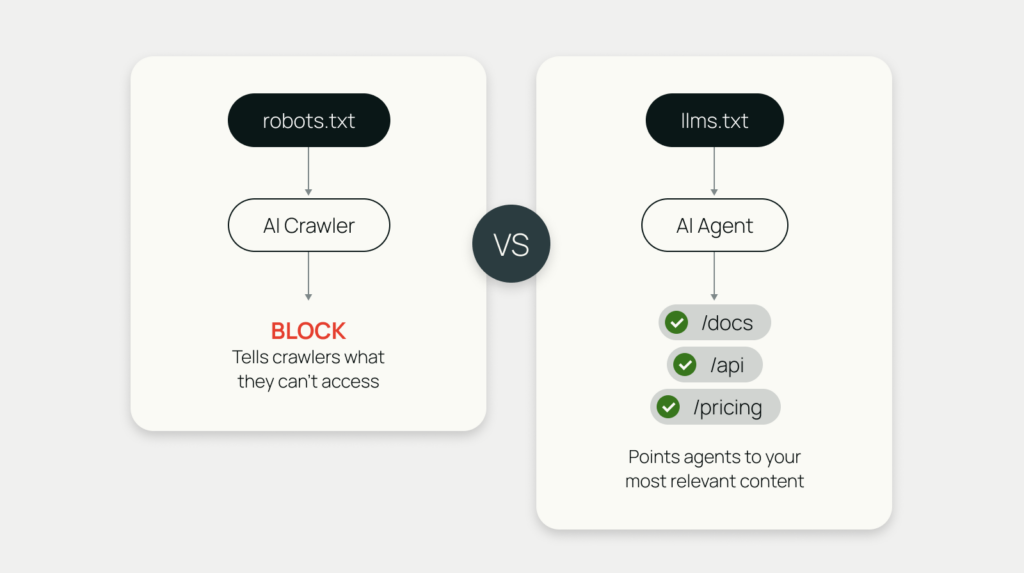
If you've seen llms.txt compared to robots.txt, that's not wrong and in fact it was directly inspired by it. Both are simple, standardized files that live at the root of your domain and give automated systems structured guidance about your site. But they work in opposite directions: robots.txt tells crawlers what they can't access, while llms.txt tells AI agents what they should go to. Same spirit, different job. There is one important caveat they both share, though: neither file physically forces compliance. Just as robots.txt is really just an instruction manual that bots can choose to ignore, llms.txt relies on AI agents actually choosing to use the map you've provided.
Think about it this way. When you were in school and needed to look up when a historic event occurred or the formula for a chemical reaction, would you flip through your textbook page by page? Absolutely not. That would've been a waste of time.
What you did ( hopefully) is use the table of contents or index to get right where you needed to go.
That's essentially what an llms.txt is. Per llmstxt.org, the standard's purpose is to provide a clean, structured entry point for LLMs and AI agents . It’s a simple markdown file that points to the most relevant, high-signal resources: documentation, APIs, structured data endpoints, key pages. Think of it as a directory that helps autonomous agents (like coding assistants or research bots) find what they need without burning tokens crawling an entire site.
And this is where a lot of the confusion creeps in: llms.txt is not a place to stuff marketing copy or brand messaging hoping LLMs will give it extra weight. That's not its purpose, and it's not how it works. Your website and the quality of the content on it still does that job.
The llmstxt.org spec is intentionally minimal. The only hard requirement is a title. From there, the file is meant to include brief descriptions of what your site or product does, and links — specifically links to documentation, APIs, or other machine-readable resources that an AI agent would actually need to take action.
The operative word there is agent. This standard was built with agentic browsing in mind: AI systems that don't just answer questions but actually do things — pull API data, complete tasks, navigate workflows. Google's own Chrome team has started acknowledging this explicitly. Their Lighthouse documentation for agentic browsing specifically calls out llms.txt as part of a forward-looking set of signals for helping AI agents interact with your site more efficiently.
Google Search's AI optimization guide echoes a similar principle: structured, accessible, high-signal content helps AI systems understand and surface your information. llms.txt is one expression of that — though notably, Google has not said it will treat llms.txt as a ranking signal. The value is functional, not algorithmic.
Here's the honest answer: for most sites right now, llms.txt is not urgent. Google is being vague about it. LLMs don't require it to crawl or cite your content. It won't single-handedly move your brand visibility in AI answers.
But we are moving fast toward a world where agentic AI is the norm, a world where users aren't just asking chatbots questions but deploying AI to complete tasks on their behalf. If your site has documentation, APIs, or structured resources, an llms.txt today is low-effort infrastructure for a future that's approaching quickly. If you're already building for agentic features, it's a meaningful signal of readiness.
The way I think about it: implementing llms.txt is less like installing a new engine and more like labeling your filing cabinet. It doesn't change what's inside. But when an agent shows up needing to find something fast, you'll be glad it's there.
Mike Witham and Rachel Bascom cut through the noise on what LLMs actually reward — and AI-generated filler isn't it. They break down what trustworthy content looks like to a model that's seen everything.
llms.txt is an emerging, evolving standard. It's not a shortcut to AI visibility. It's not a replacement for good content, clear site architecture, or authoritative expertise, and knowing your audience. But it is a reasonable, and fairly easy, low-cost step toward being ready for what's coming.
Keep an eye on it. Understand what it actually does. And when it makes sense for your site, implement it the right way.
A potential customer asks an AI tool for a recommendation. Your brand has the expertise, the service, the proof, and the answer they need. It seems like it’s a match made in search-marketing heaven. But then the AI response cites three competitors and leaves you out entirely.
That’s the kind of problem being faced by today’s marketers. Search visibility is no longer limited to rankings and clicks; it also depends on whether AI systems decide to highlight your contributions. And understanding how to encourage those systems to give you your shot means thinking beyond traditional search engine optimization (SEO).
Generative engine optimization (GEO) is a new frontier in search… one that requires not only a revised approach, but an updated marketing mindset.
OK. If you’re reading this post you’re probably familiar with the idea of AI search, so I’ll just do a quick recap: Instead of sorting through SERPs, users can now ask ChatGPT, Perplexity, Gemini, Copilot, Claude, or Google’s AI-powered results for direct responses to their search queries. The answer may include citations, brand mentions, summaries, comparisons, or recommendations — but in more and more searches, one thing it doesn’t include is a click.
This has led to a sometimes heated (for marketers, anyway) debate that centers on GEO vs. SEO and whether traditional search strategy is still enough on its own. The answer, inconveniently, is no. SEO still does the foundational work of helping content get discovered, indexed, ranked, and clicked. But GEO determines whether that same content is clear, credible, and structured enough to be used.
In the new AI-centric search environment, your brand needs to establish its presence in more than one place. Ideally, that means being mentioned in the AI Overview, cited as a source, present in organic results, visible through search ads (where appropriate), and supported by any SERP features that help the user make a decision.
Traditional search engines provide options. Answer engines provide synthesis. They collect information, interpret the query, and return something that feels more like a destination than a map. The AIs aren’t standing between you and the solution; they’re sorting through the available info and presenting the (hopefully) best parts to you in a way that is much more accessible.
That does not mean traditional SERPs are dead. People still search, compare, click, skim, abandon pages for no clear reason, and return three days later from a different device like nothing happened. But AI platforms are increasingly becoming central to that journey. Especially when users want fast answers or support. Search is becoming less of a single path and more of an intricate spiderweb of touchpoints, with SEO and GEO helping brands appear in the various places where people now go to get answers.
The kicker is that ranking well does not guarantee inclusion in AI-generated responses. AI systems tend to favor content that is unambiguous, current, authoritative, and easy to interpret. If a page has strong rankings but buries the answer under meandering language and an early-2000s obsession with keywords, it still may not be useful enough to cite.
And just so we’re clear, a lot of those elements I just mentioned that AI systems gravitate toward are the same things that have always helped content rank well. It’s just that AI search has less patience for content that makes the answer difficult to extract. Traditional SEO may reward a strong page even when the good stuff is buried; AI systems are more likely to move on and cite the source that says the useful thing clearly. As a writer, I hate this (I think language should be a journey). But as a marketer I can see the value in getting right to the point.
AI Search requires information to be complete, unique and delivered efficiently to bots and agents. And that means being visible to potential customers now comes with the prerequisite of being visible to AI.
Like I said, the two approaches overlap. That’s good news for marketers! It means you can focus on strategy without having to pick one over the other. GEO and SEO should be working together to support the same customer journey. Even so, there are a few major distinctions you need to be aware of.
SEO focuses on rankings, impressions, organic sessions, click-through rates, and conversions. By comparison, GEO prioritizes inclusion in AI answers, citations, mentions, and accuracy of representation. That means that, in addition to standard keyword coverage, optimizing content for generative AI requires direct answers, consistent terminology, credible support, and information that can hold its shape outside the original page.
The goal of SEO is usually to get a user to click through to a website. GEO often operates in zero-click environments, where the user may get enough information directly inside the AI interface and thus never needs to visit the website at all.
But wait, if there’s no click to be had, why are we bothering?
The answer is that the value is still there; it just shows up differently. A buyer may see your brand in an AI-generated comparison, search for you later, revisit through branded search, and finally convert after talking with your sales team. And when your brand appears across multiple search surfaces — AI Overview mentions, citations, organic listings, paid ads, and SERP features — you create more chances to reinforce trust before the user ever reaches your site. But if your reporting only cares about the first click, that potential influence remains untapped.
For SEO, teams should continue tracking:
For GEO, the measurement model should expand to include:
Taking this big-picture approach will help you answer the most important performance question in modern digital marketing. Namely, were you part of the answer that shaped the buyer’s next step?
The marketers who reach the C-suite aren't the ones who mastered a channel — they're the ones who could tie it to an outcome. This short video breaks down the specific gap that stalls talented marketers before they get there.
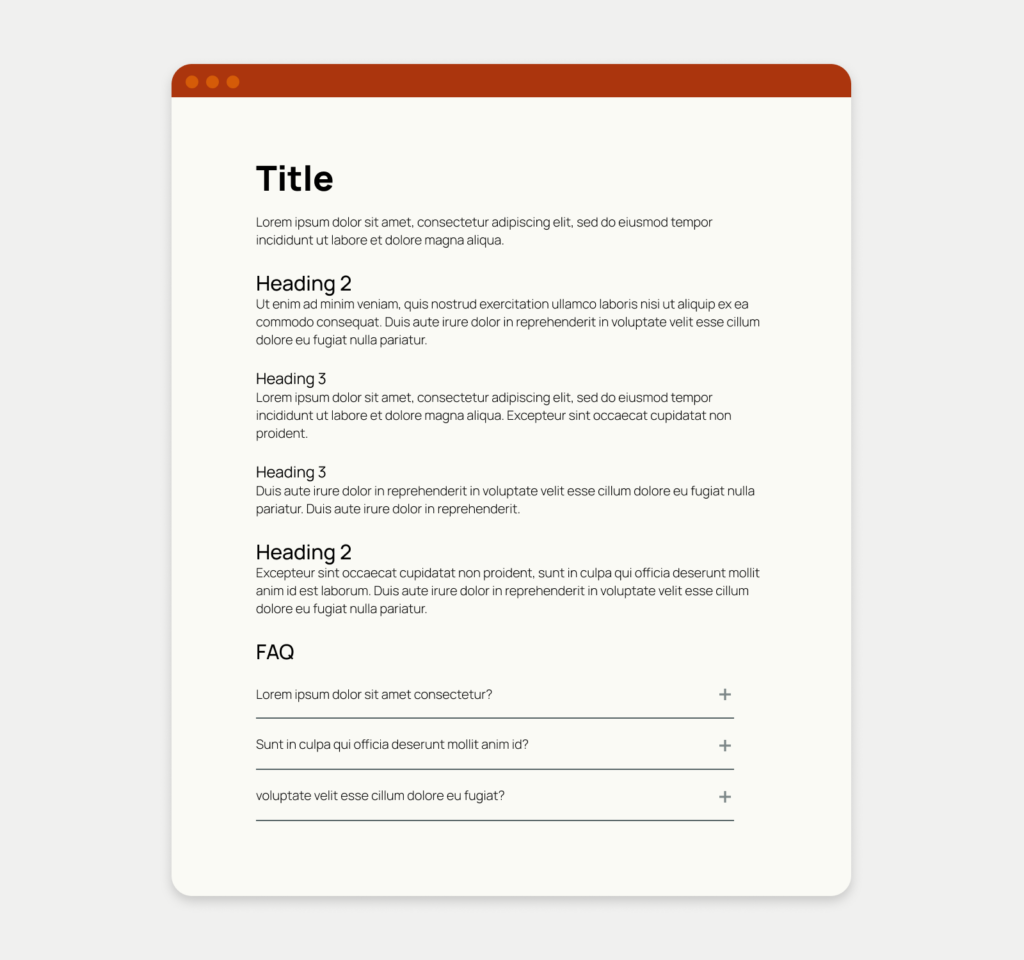
Content needs to be easy for AI systems to parse, summarize, and trust. But before you go draining your content of any semblance of personality, take a step back. Remember: The goal is to make the useful parts easier to find. There’s no reason you can’t do that while still creating something engaging, entertaining, and inspiring on a personal level.
So, if you’re asking how to optimize content for AI search, start here:
Weak SEO makes AI visibility harder. If your content is difficult to crawl, poorly organized, thin, slow, or disconnected from the rest of your site, you are asking AI systems to look someplace else for a source that knows how to cross its Ts. SEO helps build the technical foundation and broader web presence, while GEO helps that presence become clear enough to cite, mention, and reuse.
Just to reiterate this point as explicitly clear as possible: SEO shouldn’t be fighting against GEO. A modern hybrid approach to search engine optimization is about optimizing for all parts of the journey — one that can easily start with an AI overview before transitioning onto more traditional search paths that ultimately lead into a conversion.
If your current SEO program is doing well, then good. That gives you a stronger foundation. But prominent spots on the SERP do not automatically mean your content is ready for AI search. That sucks, but here we are.
So let’s get introspective. Use these questions to assess where you stand:
97th Floor approaches AI search as part of a larger search ecosystem for a truly hybrid digital-marketing strategy. The focus is on using SEO as the foundation of GEO and connecting the pieces that determine visibility:
We recognize that fragmented tactics create fragmented results. Strong rankings without AI readiness can mean your zero-click audience never sees what you have to offer. 97th Floor has the experience and innovative drive to connect the technical foundation of SEO with the answer-first demands of GEO, preserving your brand’s place in the conversation.
Contact 97th Floor today, and optimize your content for both search engines and AI.
