



Cybersecurity buyers are hard to impress. Ranging from CISOs to security architects, your audience is deeply technical, highly skeptical, and usually immune to generic B2B marketing.
They don’t care about buzzwords or brand storytelling. They do care about substance: what your product actually does, how it solves real security problems, and why they should trust you over a dozen lookalike competitors. Smart, intentional marketing is a must-have skill in the cybersecurity space.
At 97th Floor, we build cybersecurity marketing strategies that reach decision-makers and influence every stakeholder in the buying committee. We’ll break down the best practices we’ve observed, backed by ad examples and persona insights.
Let’s get into it.
Cybersecurity marketing is the specialized practice of promoting cybersecurity products or services to highly technical, security-conscious audiences. It goes beyond traditional B2B marketing by focusing on decision-makers like CISOs, SOC analysts, and IT leadership, all personas who demand depth, clarity, and provable value.
Effective cybersecurity marketing combines SEO, content, advertising, and design to engage buyers throughout a long, complex sales cycle. This involves building credibility, addressing real threats, and positioning your brand as a trusted solution in an oversaturated market.
As you might have experienced, Cybersecurity is a high-stakes environment where mistakes can cost millions (and your audience knows it). The technical acumen of your buyers means any hint of fluff or oversimplification can tank your credibility.
Other challenges include:
To break through, cybersecurity marketing needs to be as intelligent as the people it’s trying to reach. That means aligning every campaign with how your audience thinks, what they’re solving for, and how they evaluate vendors.
Where traditional B2B campaigns can succeed with broad messaging, cybersecurity campaigns must go narrow. They need to:
Bottom line: If your marketing isn’t built for security buyers, it’s not built to perform.
Creating a high-performing cybersecurity marketing strategy means throwing out the one-size-fits-all B2B playbook. We’ve dug through our history as a cybersecurity marketing agency to identify six principles that drive success in cybersecurity marketing, each paired with a unique ad example. Use these tips to help you take your next cybersecurity campaign to a new level.
You’re not marketing to “security teams.” Remember your target, whether it’s marketing to a CISO who oversees a sprawling enterprise, or a SOC Analyst who lives in alerts. Specificity is non-negotiable in cybersecurity marketing, because vague messaging gets ignored.

Darktrace succeeds here by getting specific. Not only are they directly calling out CISOs, but they’re tackling only one facet of security: email. This approach self-eliminates some audiences, but ensures that those who do interact with the ad are likely higher-intent. The headline text could be helped by offering some specifics about what the whitepaper offers, but the ad maintains strong branding and a strong call-to-action.
Brainstorm: What’s the most specific piece of content you can offer to your audience? How can you write ad copy that hits on just one pain point and offers one precise solution?
Cybersecurity buyers are burned out on abstract “platform” talk. What do they actually want? Time back. Fewer compliance headaches. Less operational friction. When your value proposition addresses those second-order benefits, it lands harder.

Identity security company CyberArk’s ad pinpoints a problem experienced by their customers: losing so much time finding the right security solution and dealing with compliance, that important projects get deprioritized. Rather than focusing on CyberArk’s product offerings, the ad leans on a secondary benefit that prospective buyers are eager for. A simple design and minimal colors make the ad visually appealing, and the offering of a personalized audit and compliance call is a strong call-to-action.
Brainstorm: What is the most significant benefit that your solution provides to your audience?
If you’ve been recognized by Gartner or Forrester, or if your solution meets hard-to-hit compliance benchmarks, by all means say it. Security professionals are looking for signs that you actually know what you’re doing. A little proof goes a long way.

Crowdstrike leverages Gartner’s authority in this ad, highlighting their place on Gartner’s Magic Quadrant. Gartner is a trusted source on cybersecurity and IT solutions for CrowdStrike’s audience, and using this report for advertising is a brilliant and low-effort win.
Brainstorm: Have you won any awards or accolades that you can put on an advertisement? What about client testimonials?
Cybersecurity buyers are lifelong learners. They respond to content that teaches them something new, especially when it’s visual, data-driven, and skimmable. If your brand can help them stay sharp, you earn trust and attention.

A10 Networks’ use of data visualization is a great idea. People are more apt to engage with graphs, statistics and data than a chunk of text. This chart invites A10’s audience to see how they stack up against their peers concerning TLS/SSL inspections, and the ad’s call-to-action implies that there is more to learn about how technology leaders consider decryption solutions.
However, this chart isn’t the easiest thing to swallow. This ad would be stronger with just a single metric or with a more simple visual from their data. As is, the ad requires too much of its viewer and, by failing to supply any conclusions about this data, leaves too much ambiguity about where this information puts its audience in relation to A10 Networks.
Brainstorm: What data can you share with your audience that will make them want to learn more about you?
The best cybersecurity brands shape how the industry sees threats. Establishing thought leadership through bold, creative design and clear messaging makes your brand feel indispensable.

Palo Alto Networks’ ad stands out for cohesiveness between copy and design, strengthening the impact of the ad’s message. Pairing the idea of unknown threats with the impression of half-turned blinds evokes that eerie feeling of being watched by something unseen. This strengthens the ad’s promises of protection for “whatever, whenever, wherever.” Palo Alto Networks is positioning itself as an omniscient and omnipresent security solution, putting a certain 2006 babysitter receiving threatening phone calls customers at ease.
Brainstorm: What objects symbolize safety or privacy to your audience? How can you use those objects to create something visually interesting?
Let’s be honest, most cybersecurity ads look like they were built from the same uninspired template. But a little creativity goes a long way—especially when it surprises, entertains, or reframes a threat in a clever way.

All cybersecurity ads pretty much look the same, so we love it when a brand breaks out of the B2B monotony like Carbonite has. The visual analogy is straightforward and intriguing, demanding a pause and inviting a chuckle from its audience. With simple, unique ad creative, Carbonite establishes that its security solutions are so good that its customers can be completely unbothered about threats - even threats as sinister as prowling predators.
Brainstorm: What analogies does your brand or product lend itself to? How can you use that to surprise your audience?
To build a cybersecurity strategy that drives pipeline, you need to know who you’re talking to, what keeps them up at night, and how they influence the buying process. Each persona plays a different role, and each one needs a tailored message.
Below are four common groups we build campaigns around, with tips on how to reach them.
CISOs and Security Leaders
What they care about: Risk reduction, cost justification, strategic alignment
How to market to them: Be brief, credible, and focused on outcomes. CISOs aren’t deep in the weeds—they’re trying to evaluate whether your solution moves the needle on security posture or operational efficiency. Give them high-level proof points, ROI-driven messaging, and third-party validation like analyst reports or compliance frameworks.


Security Practitioners and Implementers
What they care about: Technical specs, real-world application, peer trust
How to market to them: These are the engineers and analysts who will poke holes in your claims. Your marketing needs to speak their language and show technical depth. Use product walkthroughs, architecture diagrams, feature comparisons, and use-case content that demonstrates exactly how your solution works in practice.
IT Decision Makers
What they care about: Integration, scalability, cost, security trade-offs
How to market to them: This group sits at the intersection of IT and security. They want solutions that won’t break their systems or their budget. Emphasize interoperability, performance, and ease of deployment. Case studies and pricing calculators can help them make a confident decision.


Boards and C-Suite
What they care about: Business risk, liability, brand protectionHow to market to them: You're not selling features—you’re selling peace of mind. Frame your messaging around financial impact, regulatory compliance, and business continuity. Use concise, high-trust formats like executive summaries, brief videos, or benchmarking data to support your case.
Marketing in cybersecurity is a high-stakes game. There’s less room for error, more skepticism in the room, and a shorter window to prove your credibility. Here are some do’s and don’ts that help keep cybersecurity campaigns focused, effective, and persona-aligned.
Do speak to specific personas.
Generic messaging gets ignored. Tailor every piece of content, ad, or landing page to one specific role and pain point.
Do lean on data and authority.
Use trusted sources like Gartner reports, industry benchmarks, and analyst quotes to back your claims. Show, don’t tell.
Do invest in content depth.
Your audience can sniff out fluff in a second. Write with substance. Collaborate with your SMEs. Make every piece worth your reader’s time.
Do prioritize technical accuracy.
One wrong detail can undermine the whole campaign. Double-check product specs, terminology, and claims, especially in visual assets.
Do align with the buyer journey.
CISOs don’t click “Buy Now.” Build layered campaigns that nurture interest across awareness, consideration, and validation stages.
Don’t overpromise.
"Total protection" or "unbreakable security" won't land and could backfire. Be confident, but stay grounded in reality.
Don’t assume they’ll connect the dots.
Spell out exactly how your product helps solve a specific problem. Don't rely on vague claims or industry jargon.
Don’t recycle general B2B creative.
Your cybersecurity audience has seen the same ad template 1,000 times. Differentiate with smarter, more persona-aware creative.
Don’t ignore design preferences.
Security audiences favor clarity and simplicity over flash. Avoid overly polished, “marketing-looking” assets that feel insincere.
Don’t skip the proof.
Your audience needs evidence before they trust your brand. If you don’t provide it, they’ll find a competitor who does.
Why Choose 97th Floor as Your Cybersecurity Marketing Partner?
We understand cybersecurity marketing because we’ve done it—successfully—for some of the top names in the industry. If you need to lower your CPA, hit revenue goals, or get in front of the right people, we can help. We build strategies based on research, data, and a deep understanding of how security buyers think. And we always respect your audience’s intelligence, time, and high standards.
Learn more about our cybersecurity marketing services, or get in touch to start your next campaign.
Ready to Grow? Get in touch to see what's possible for your brand.
Cybersecurity solutions buyers are worn out by the constant barrage of stale content flooding their search results, inboxes and social media.
Only brands that are willing to pause the content machine long enough to develop true empathy for their audience will be able to make any progress towards the mecca of trust and authority.
97th Floor believes that Empathy, paired with Innovation and Profitability, produces Great Marketing—marketing that fosters relationships and ultimately sales. We unlock empathy for our client’s customers through an exhaustive process of in-depth persona research and customer journey mapping.
Our customer journey maps reveal the questions, actions and touchpoints of an audience at each stage of the funnel: awareness, consideration and decision. Using these maps as a launching pad for every marketing campaign makes delivering "the right message at the right time" a reality.
The following are real persona customer journey maps created for our clients in and adjacent to the cybersecurity industry. They have been anonymized, but all other information is as-delivered to our clients.
Most buyer personas get built, presented, and shelved. This short video breaks down why — and what the ones that actually drive content decisions look like instead.
At a high level, advertising on Reddit means placing paid, promoted content directly inside Reddit communities, where users are already talking about the topics you care about. Simple enough. The catch is that Reddit does not behave like other ad platforms, and neither do its users.
Reddit is built around communities first, ads second. People come to Reddit to learn, debate, vent, and swap opinions. They are not there to be “marketed to.” That’s why advertising on Reddit works best when it feels like a natural extension of the conversation.
Instead of targeting people based on who they are, Reddit lets you target them based on what they care about. Subreddits act as self-segmented audiences, organized around shared interests, roles, and problems. When your ads align with those conversations, advertising on Reddit can feel surprisingly organic.
This community-first structure is also where the advertising on Reddit pros and cons start to show up. Done right, ads blend in and build trust. Done poorly, they stand out fast, and not in a good way.
Before diving headfirst into advertising on Reddit, it helps to understand what you’re signing up for. Reddit can be incredibly effective. It can also be unforgiving. Sometimes even within the same campaign.
One of the biggest advantages of advertising on Reddit is audience intent. People don’t land in subreddits by accident. They join because they care deeply about a topic, role, or problem. That makes subreddit targeting one of the most powerful tools Reddit offers.
Another major pro is authenticity. When ads are written in a way that respects the community and adds value, Reddit users engage. They comment. They click. They remember the brand. In some cases, they even defend it in the comments, which is about as close to a marketing miracle as it gets.
Costs can also be favorable. Compared to other paid social platforms, advertising on Reddit often comes with lower CPMs, especially for niche or technical audiences. For brands that struggle to reach specific communities elsewhere, Reddit can punch well above its weight.
The same is true for any channel that's been overlooked long enough to forget it exists. Marketer Sterling Snow shares the story of a brand that put $1,000 into a newsletter that had never run a single advertisement — and walked away with hundreds of demo requests. The audience was already gathered. The channel just hadn't been claimed yet. This short video breaks down why the highest-ROI advertising placements are often hiding in exactly the corners no one else has bothered to look.
Now the flip side.
Reddit users are highly skeptical of ads. They can spot generic marketing language instantly, and they are not shy about calling it out. If your ad feels salesy, forced, or out of place, performance drops fast.
Another challenge is creative fit. What works on Facebook or LinkedIn rarely works here. Advertising on Reddit requires more testing, more iteration, and a stronger understanding of how each community communicates.
Finally, Reddit is not a set-it-and-forget-it platform. Successful campaigns require active monitoring, comment management, and optimization. That extra effort is part of the tradeoff.
If you’re hoping for one clean number, I regret to inform you that advertising platforms do not believe in peace. Advertising on Reddit is auction-based, which means costs change based on your targeting, competition, and objective.
Most advertisers report CPMs commonly landing somewhere in the low single digits up to the teens, depending on how broad or narrow your audience is. WordStream puts “typical” CPM ranges around $0.50–$15, while also noting outliers can go much higher for premium placements.
For clicks, many guides and advertiser reports land in a practical CPC range of roughly $0.50–$4, again depending on competition and targeting.
If you’re running video, Reddit also supports CPV (cost per view) pricing models in addition to CPM and CPC.
A few things move the needle fast:
You do not need some mythical five-figure monthly commitment to begin advertising on Reddit. Reddit for Business explicitly notes there’s no minimum spend to get started, and you control budgets at the ad group level with daily or lifetime options. You can start small, learn what works, then scale what earns its keep.
At some point, every marketer asks the same question: How does advertising on Reddit stack up against Facebook or Google? The answer is not “better” or “worse.” It’s different, and those differences matter a lot depending on your goals.
Facebook and Google are built for scale. Reddit is built for relevance. That distinction shows up quickly when you compare targeting, intent, and how audiences respond to ads.
Here’s a side-by-side look at how these platforms typically compare.
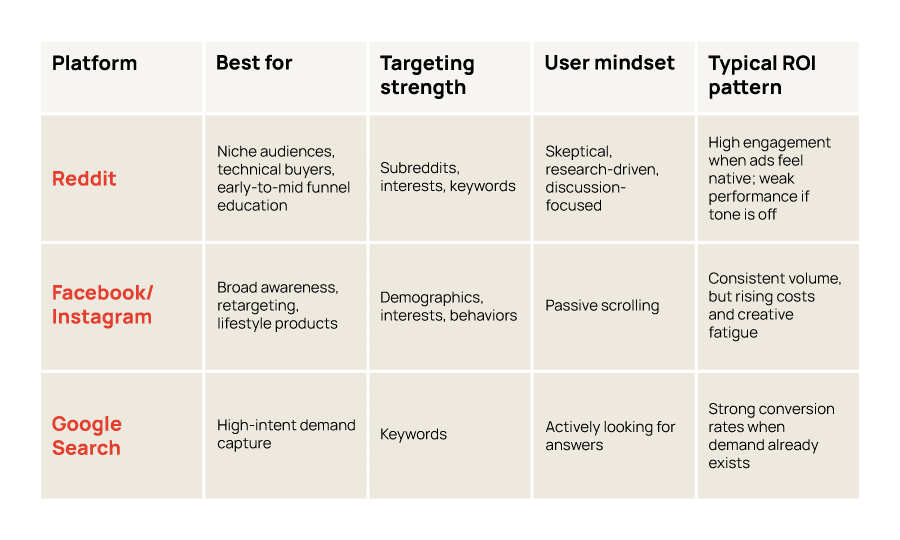
Advertising on Reddit works best when you need to reach people who are actively thinking about a problem, but not necessarily ready to buy yet. Subreddits function like built-in focus groups, where users self-select into conversations around their role or challenges.
Compared to Facebook, Reddit has less scale but far more context. Compared to Google, it reaches users earlier in the decision-making process. That makes advertising on Reddit especially useful for complex products, technical audiences, and brands that need to educate before they convert.
Reddit is not ideal for every use case. If you need immediate, high-volume conversions, Google Search wins. If your product relies heavily on impulse buying or visual appeal, Facebook and Instagram might perform better.
Reddit rewards relevance and authenticity. It punishes generic messaging and aggressive sales tactics.
Setting up advertising on Reddit is not complicated. The hard part is everything around the setup. So, we’ve made it easy with this quick guide.
Head to Reddit Ads (aka Reddit for Business) and set up an account. Basic stuff. Billing. Business details. The usual “confirm you are, in fact, a company” deal. Now, on to the good stuff.
Reddit will ask what you’re trying to do. Choose the goal that matches your actual intent, not your wishful thinking.
Common picks:
If you’re brand new to advertising on Reddit, traffic is often the cleanest starting point. It gives you a quick signal without requiring perfect tracking from day one.
This is an important step! It may determine the success of your campaign.
Start with subreddit targeting whenever you can. Pick the communities where your audience already spends time. Then layer in interest or keyword targeting if you need to expand reach or test angles. If you don’t understand a subreddit’s vibe, don’t target it yet. Lurk first, then target.
Reddit uses an auction model, so you’ll set a daily (or lifetime) budget and a bid strategy based on your objective.
Start simple:
This is where people can get impatient, but don’t. Advertising on Reddit rewards steady testing more than constant tinkering.
Now the fun part. Reddit users are ad-skeptical and very allergic to buzzwords. Write your ad like you’re joining their existing conversation.
Best practices for Reddit copywriting include:
Step 6: Launch, then monitor comments
Reddit is not a “launch and leave” platform. People may comment on your ads. Sometimes they ask smart questions. Sometimes they roast you. Either way, watching comments gives you copy insights, objection insights and product messaging insights.
Step 7: Test one variable at a time
When you start optimizing, change only one thing per test:
If you change everything at once, you won’t know what actually worked. You’ll just know you “did stuff.”
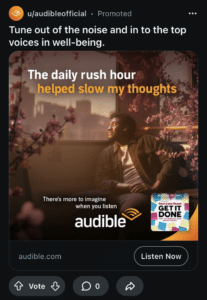
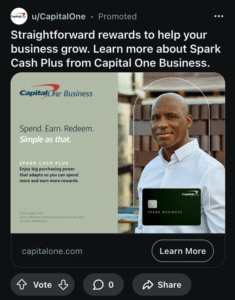
Advertising on Reddit is not for everyone, but that’s kind of the point.
Reddit rewards curiosity, relevance, and a willingness to actually understand the audience you’re trying to reach. It punishes shortcuts. If you treat it like just another paid social channel, performance will disappoint, and the comments will let you know exactly why.
When brands take the time to learn the platform and present something genuinely useful, advertising on Reddit can be incredibly effective. Especially for niche audiences, when trust really matters. Reddit is not a billboard, it’s a conversation. The brands that win on Reddit are the ones willing to listen before they speak.
If you’re ready to approach advertising on Reddit with strategy, intention, and a healthy respect for the platform, let’s build.
We know your audience. We know their interests and aversions, and we know how to talk to them so that they convert - on Reddit and everywhere else they hang out. Let us take the lead here. We’ve got you. Book a strategy call with us today.
Podcast advertising is a promising strategy for any marketing campaign, with 51% of podcast listeners agreeing that hearing a podcast ad made them more likely to make a purchase from that brand.
Cybersecurity marketers are in no drought for opportunities here, with dozens of long-running and far-loved shows capturing the ears of your audience.
We used Sparktoro and additional tools to find the top-listened podcasts from decision makers in cybersecurity; put a bug in their ear about you, yeah?
Note that this audience is extremely sales and advertising averse. They don’t appreciate self-promotion. While you can of course pay to sponsor the show and get a host-read ad in front of your audience, be extra thoughtful about your messaging and position as you do so.
Darknet Diaries has amassed a cult-like following for its deep-dive episodes exposing true, first-hand stories about “hackers, breaches, shadow government activity, hacktivism, [and] cybercrime.” Host Jack Rhysider, whose own background is in security operations, makes staggering stories accessible and captivating for both technical and non-technical audiences. The show brags over 90 millions downloads and received praise in The Guardian, Vulture and The New York Times.
Format: Guest Interviews
Update Frequency: Every first Tuesday of the month
On Air Since September 2017
Opportunities: If you happen to know someone or know someone who knows someone with an insane cybercrime story to tell, the connection may be worth making just to get your company’s name floating in Jack’s network. Otherwise, you can contact the team by emailing jack@darknetdiaries.com to inquire about sponsorship. See the complete list of active sponsors here. It includes a number of personal and professional security solutions and IT solutions.

Hosted by former NPR investigations correspondent Dina Temple-Raston, Click Here brings listeners audio stories from the “shadowy characters behind ransomware attacks, disinformation campaigns, and hacks and … the people trying to stop them.” Show topics range from “peek inside a North Korean malware lab” to “how hackers settle their disputes – think People’s Court without all the robes.”
Format: Guest Interviews mixed with investigative reporting and narration from the show host
Update Frequency: Every Tuesday and Friday
On Air Since August 2017
Opportunities: Click Here belongs to an ecosystem of cyber-related news produced by The Record from Recorded Future News. The publication sends a daily newsletter to its audience of “hundreds of thousands” via a mobile app.If you have a news tip, and perhaps an expert to lend, about cybersecurity startups, cybersecurity attacks, or policy surrounding privacy, disinformation or cybersecurity policy, you can pitch your story by reaching out to therecord@recordedfuture.com. The show also has in-show advertisements, maybe one per episode or so.
“2.5 Admins is a podcast featuring two sysadmins called Allan Jude and Jim Salter, and a producer/editor who can just about configure a Samba share called Joe Ressington.” The show covers tech news and answers listener-submitted admin-related questions.The show’s audience is well-educated high-earning IT professionals.
Format: Conversational
Update Frequency: Weekly
On Air Since April 2020
Opportunities: The show welcomes interested sponsors to get in touch at show@2.5admins.com.
Late Night Linux is a family of seven podcasts, including 2.5 Admins, all about "Linux, open source software, and systems administration.” Late Night Linux was the group’s first show, and covers all things free and open source software.
Note that the show contains explicit content.
Format: Conversational, doesn’t appear to host guests
Update Frequency: Weekly
On Air Since December 2016
Opportunities: To advertise on any of the Late Night Linux shows, contact joe@latenightlinux.com.
Hosted by Kurt Seifried and Josh Bressers, Open Source Security Podcast delivers weekly conversations on all things IoT, application security, operational security, cloud, devops, and security news.
Format: Two hosts
Update Frequency: Weekly
On Air Since September 2016
Opportunities: You can email the hosts from their website. Both Kurt and Josh are active on infosec.exchange, part of a decentralized social network powered by Mastodon. Sounds like a good place for some audience research, at the very least.
Hosted by cybersecurity veterans Graham Cluley and Carole Theriault, Smashing Security offers a “helpful and hilarious take on the week’s tech SNAFUs.” Winner of the "Best Cybersecurity Podcast" in 2018, 2019, and 2023, and the "Most Entertaining" in 2022 and 2023, Smashing Security has had over nine million downloads.
Note that the show contains explicit content.
Format: Two hosts, occasional guest interviews
Update Frequency: Weekly on Wednesdays
On Air Since December 2016
Opportunities: Smashing Security has generous options for sponsors, including opportunities “for sponsors to appear in 15-minute featured interviews included within the podcast.” To learn more about sponsorship, email studio@smashingsecurity.com. Smashing Security also conveniently features all past episode guests on a nice list. Pursue it and let ideas flow: who in your organization would fit here? Guest list.
Running for nearly twenty years, Security Now offers weekly conversations on security topics such as malware, ransomware, and hacks; digital identity, data privacy, and policies; hardware and IoT security concerns; software and plug-in security patches and updates; and many more. The show hosts are cybersecurity authority Steve Gibson and technology expert Leo Laporte, each bringing “their extensive and historical knowledge to explore digital security topics in depth.”
Format: Two hosts
Update Frequency: Weekly on Tuesdays
On Air Since August 2005
Opportunities: Security Now belongs to the TWiT faTmily of podcasts, a group that amasses a yearly audience of 25 million downloads. TWiT’s podcasts have built a relationship with listeners over several decades, which is great news for you; not only is 88% of TWiT’s audience tech or IT decision makers, but 88% of listeners have actually made a purchase based on a TWiT host-read ad. Get started by emailing advertise@twit.tv.
Risky Business Media was founded in 2007 by cybersecurity journalist Patrick Gray. A rotating group of hosts including Patrick and others publish multiple episodes each week for their audience of cybersecurity professionals.
Format: Host conversations
Update Frequency: Weekly
On Air Since February 2007
Opportunities: Risky Business’ audience is “top heavy,” meaning that a majority of their more than 25,000 weekly listeners are CISOs or information security decision-makers. View Risky Business’ media kit for more information about their audience, and contact sales@risky.biz for pricing. You can also reach out with editorial opportunities. Note that Risky Business Media also publishes two cybersecurity newsletters.
There are two ways to target your audience vis podcast advertising. The first is with baked-in or title-by-title targeting. Baked-in ads are added to the podcast audio file itself, making them permanent. This means that all listeners will hear the same ad when they listen to that episode of the show, regardless of their location, demographic or when they hit play. These ads can appear anytime in an episode and can be longer than thirty seconds.
Dynamic insertion or audience network podcast advertising inserts ads into ad spots (pre, mid, or post-roll) which can be targeted to the person listening. This allows podcasters to keep the advertising on their shows fresh, and it allows advertisers to select contextual targeting and third-party segments. The ad is then inserted in whatever shows that audience is listening to.
Host-read ads are created and voiced by a show’s host, and are usually read in the style of the show. Because of the host’s narration, these ads seem like a personal endorsement to audiences.
Host-read ads are a great choice for most cybersecurity podcast ads because the target audience aligns closely with specific podcast shows, like those listed above. We can select a show or a few shows and have host-read ads for cyber solutions during those shows.
PRO TIP: For host-read ads, it’s best practice to give the host bullet points instead of an actual script. This way you can make sure that what you want covered gets said, but the host has the opportunity to make it seem more authentic to them.
PRO TIP: Make the host your advocate. Build a relationship with them. Let them experience your product as best they can so that they can speak authentically to their trusting audience.
Pre-recorded ads are scripted by an advertiser and then recorded by a voice talent before being added to the podcast pre, mid, or post-roll. This type of podcast ad is best if your podcast advertisements won’t be on one specific show.
For example, using a title-by-title approach doesn’t sense if your targeting requires a geographic restriction.
Here, we can pick contextual targeting so the podcast episode has to be about that topic. Then, we can also layer on third-party segments, such as the user interests or experiences. Finally, layer on location targeting..
A voice talent will read the pre-recorded ad that can then be dynamically inserted whenever a podcast listener meets all of those requirements.
It all depends on your budget, goals and even the length of your spot. Compare each spot below.
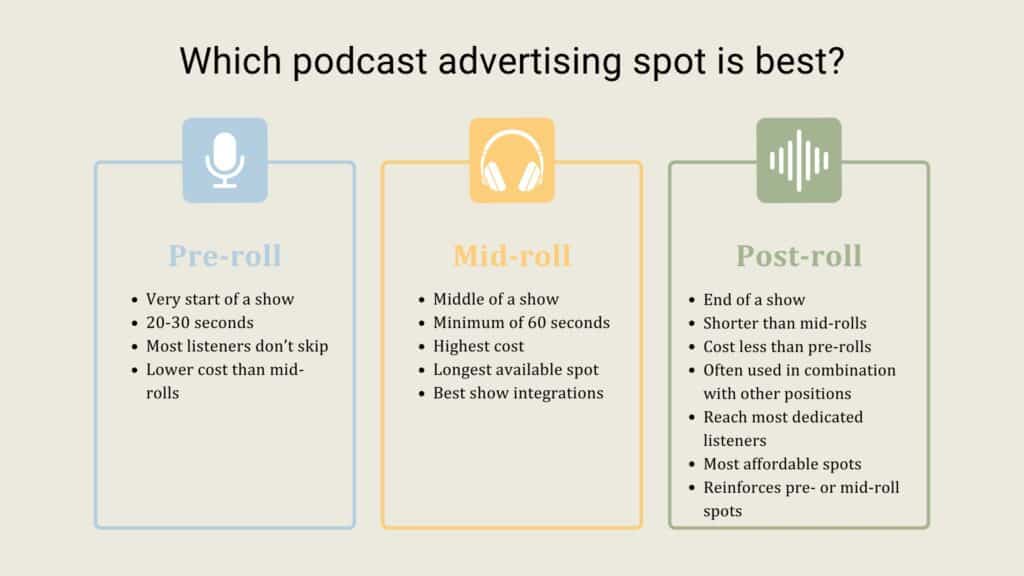
Podcast ads aren’t clickable in most cases, so they are definitely a top-of-funnel awareness play. However, you can drive action from a podcast ad by having a great offer. Most podcast ads have a very enticing offer such as saving a certain percent on a product or a first month free.
PRO TIP: Longer campaigns outperform short ones. Run ads on at least 5 episodes of a podcast to improve recall by 39%. Make each spot different to prevent audience tune-out.
While counting episodes downloads will tell you impressions, use these four tactics to get better success metrics from your podcast advertising.
Story-telling is essential for podcast ads. You don’t have a visual component to draw people in, so you’ve got to hook them with words.
And remember, the offer is so important. Podcast advertising isn’t the most straightforward journey. It’s not like clicking on a LinkedIn ad. We’re asking the user to go to our website manually, so we better offer them a good reason why they should!
See how an audience-first approach translates to bottom-line results.
